Features
Your startup has entered the market, and you are wondering what to focus on first. When starting any business you must go through certain stages, so startups focus first on product development, then on building a customer base and establishing a positive cash flow.
The way in which consumers are searching for products online has changed. In recent times, there has been a significant increase in question-based searches from consumers looking for quick solutions to their needs, overtaking direct searches for brand names. It’s clear the consumer environment is evolving, so what can be done to ensure existing and emerging businesses can keep up?

Today’s smart cities are transforming the way we live, work and play. But far from being just a 21st-century gimmick, there are significant, even life-changing, advantages to the implementation of smart technology in cities around the world.

What a year for venture investing. Crunchbase recently released figures that show venture funding soared to a total of $288bn for the first half of 2021. This represents an all-time record high and four times the level of VC spending four years ago! With all this money raised, it seems natural that venture funding would be the first port of call for startup founders. However, that view is based on several myths. Sometimes venture capital is simply not the right fit for many businesses. And I say that as a venture investor myself.

According to the NHS, a carer is anyone who looks after a family member, partner or friend who needs help because of their illness, frailty, disability, a mental health problem or an addiction and cannot cope without their support. The care they provide is unpaid. Staggeringly, 13.6 million people in the UK have unpaid caring responsibilities, most of whom also work.

The economic landscape of the past eighteen months has been interesting to observe, to say the least. While many organisations have been able to carve out a new niche under pandemic conditions; indeed, some have even flourished, a vast swathe of enterprises have been unable to translate their operations to a radically altered business landscape, and have fallen by the wayside.

COVID-19 introduced new changes and accelerated already existing ones in the ways we work and interact with one another within our organisations. As we adjust to the new ways of working and work at breakneck speed to return back to normality, Roxana Mohammadian-Molina, Chief Strategy Officer at FinTech company Blend Network, argues that it is more important than ever for businesses and their leaders to champion inclusive growth.

Businesses today are expected to take sustainability seriously. This is certainly an ethical responsibility at a time in which society is running headlong into the irreversible effects of climate change. It is also demanded by consumers across generations.

When it comes to holistic living, doctors, psychologists, and life coaches have a lot to say. It’s not really the place of business founders to be handing out lessons, after all, they’re known for being work-obsessed and putting in long hours. But, they do know a thing or two about what it’s like starting and growing a business,

Since Google rolled out its core web vitals update in June 2021, there have been visible ranking changes for many websites. Numerous reputable websites that had previously had top rankings for their targeted keywords saw a decrease in ranking, on the other hand, smaller websites experienced an increase in how Google ranked them in June and July 2021.
When running a new brand, your time is extremely limited. You need to make inroads in a market that’s already dominated by big brands, and your resources are far more stretched compared to the existing competition.

A study shows that 90% of ecommerce stores shut down within 120 days of their launch. While running an estore is a lucrative business, you cannot underestimate the risks associated with it.

As many companies across the UK finally start returning to office life with cautious optimism, workplace inclusivity should remain one of the most important goals for any organisation.

As a provider of data cleaning services to businesses large and small, REaD Group is always keen to find out what the needs of our clients are. As such we conducted a survey into SMEs to look at what they knew about GDPR, how they hold and manage their customer data and what they do to keep it clean and up to date.

We’re currently in the midst of what many are calling a ‘startup boom’. More than 4.4 million new businesses have been created in the US since last March, according to the Census Bureau – the highest amount ever seen since records began in 2004.

The last 18 months have been tough for everyone. We have witnessed limitations on all aspects of our everyday lives and experienced things that we never imagined could be possible. But for entrepreneurs, the unprecedented challenges that unfolded following the start of the pandemic have resulted in the unfortunate failure of many businesses and irreversible damage to industries worldwide.

You’ve got the idea, the business plan, the tech and – some of – the funding. You’re working on your product, iterating features, fine tuning the customer service, revolutionising a sector’s status quo. And you’re moving fast, because of your ecosystem’s need for speed. For most tech startups, those are the pillars they build a business on. But what’s the value of these if no one is paying attention? And if what your offer is so complex and new that people don’t understand it?

At last, Freedom Day is here. We’ve long waited for government restrictions to ease, yet what this will look like within an office environment is still all very new. Companies everywhere are having to make new decisions that will impact the daily lives of their employees.
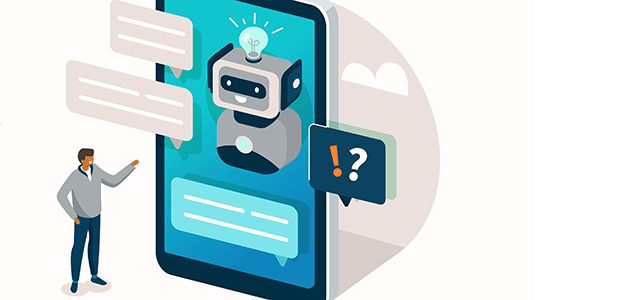
Chances are, you have probably had some sort of engagement with a chatbot in the past. These technologies are used by an array of organisations, usually in an attempt to create a much more efficient customer experience, and in many circumstances, cut costs along the way. However, these solutions are not always up to the task.

Environmental policies and working towards sustainable practices has been a hot topic among businesses across sectors and, crucially, across scales. While larger established enterprises are naturally responsible for a larger share of the productive overhauls required to attain Britain’s environmental targets, startups and SMEs are also increasingly outlining their commitment to sustainability.