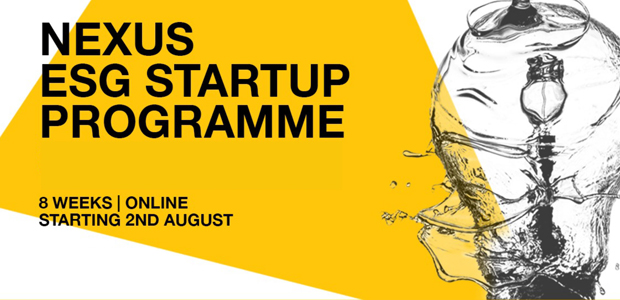
The NEXUS ESG Startup Programme is designed to give founders the practical knowledge to launch and scale their creative and digital businesses.

With government changes from 19 July, the question being thrust into the limelight more than ever for many is ‘Should we go back to the office?’

Kuano.ai, a software platform for rapid, cost effective quantum modelling of enzymes, has raised £1m in seed funding from ACF Investors, o2h Ventures and a syndicate of Cambridge-based angel investors. The funding will accelerate the company’s growth as it moves further towards commercialisation.

Whether it’s an online fashion business or a breakthrough idea for a new financial service, starting a business today will invariably require some elements of a digital journey between the product or service and the end user, if not in its entirety.

As a startup founder, it’s easy to view your business solely from your own perspective. Your startup idea is surely unrivalled in its brilliance, bordering on genius, beyond comparison.
While many industries suffered in 2020 with the ongoing health crisis, cyber crime and in particular ransomware grew significantly. With more time spent online by individuals, and the switch to remote working for many businesses, bad actors recognised the opportunities for increased cyber attacks and grabbed them with both hands. The bad news – this trend is going nowhere in 2021.

Unibuddy, the number one peer-to-peer university recruitment platform that has helped 770,000 students from over 180 countries make better decisions about their higher education journey, has raised $20m in funding. The Series B round was led by Highland Europe with additional participation from Stride.VC. Unibuddy has raised a total of $32m since its inception in 2017.

It has been a record first half of the year for VC investment into London’s fintech sector, with new research from Dealroom.co and London & Partners revealing London-based fintech firms have already raised more VC investment than any other year, in only six months.

Chocolate is probably not the first thing that springs to mind at the mention of blockchain technology. However, it’s that precise combination that is helping to bring an end to over 50 years of civil war in Colombia which has killed over 200,000 people and internally displaced millions.

European Innovation Council (EIC) Fund is investing €5m in the Israeli medical startup, NanoVation, for accelerating the development of its high accuracy respiratory monitor and for launching initial marketing efforts in the EU. The investment is part of the EIC’s strategy to identify and support high impact startups and small companies and assist them in scaling up game changing technologies.

Bia Care has launched its virtual clinic to improve menopause care by combining technology with personalised treatments. The remote care solution ensures that women are provided with the knowledge needed to control their symptoms, access clinically-validated treatment options, and are given the ability to share their experiences in a confidential setting.

As you can imagine, here at Startups Magazine HQ, we speak to an awful lot of early-stage businesses. Every so often however, one really stands out and lingers long in the memory.

The Government’s policy on face-masks will create ‘misery and confusion’ for workers using trains, a transport expert said today. Dash Tabor warned Boris Johnson’s plan to scrap mandatory coverings may also lead to millions of employees steering clear of public transport.

The economy has shifted. More and more people are becoming business owners or self-employed, so why are so few entrepreneurial skills taught in schools? From a young age we should all be learning how to innovate, collaborate and communicate effectively so that we are better prepared for the world of work. Edtech is perfectly equipped do this effectively, as well as encourage lifelong learning so that as adults we can all upskill and reskill easily.

It’s a challenge, being a challenger brand today. The relative ease and speed with which you can bring a company or product to market means the volume of brands in any given space is huge, so conveying genuine differentiation is hard. And staying the course, building a challenger that lasts, is even harder.

Running a small business can be hugely rewarding but also hugely frustrating. You have the perfect product, website and sales process in front of you, but getting in front of the perfect customer, and then scaling this, is a battle that we have all have to face. Often, SMEs will be time poor and resource limited, with individuals covering a range of different roles, making it hard to scale effectively.

MSDUK, an organisation that champions the inclusion of Ethnic Minority Businesses (EMBs) and founders in corporate supply chains, has partnered with Unilever, WPP, Google and Dow to launch the UK’s first accelerator programme focused on helping 300 EMBs to become supply chain ready.

An ambitious UK tech firm is aiming to take on US celebrity video calling service Cameo – by launching a ‘bigger and better’ platform.

The future of the office remains uncertain, and the recent speculation around changes to the right to work away from the office only muddies the waters further. Regardless, many large businesses such as Amazon are already planning their return to an office-centric culture to enable collaboration. Google also revealed that 60% of its workforce would be in the office a few days a week, with only 20% of the workforce working remotely.

An entrepreneur is often so in love with their idea, so confident in its perfection, that they begin to sin. And if it continues, they can torture their child with this selfish love.