
Every founder reaches a moment where growth becomes harder than it used to be. Early expansion might come from a great product, strong word-of-mouth, or the founder’s own network, but scaling beyond that can be a different game entirely. That’s where many startups find themselves stuck – growing, but not fast enough; investing in ‘random acts of marketing’ but not seeing a return; and spending more time being reactive and tactical rather than proactive and strategic.

Every entrepreneur dreams of scale. You have proved your product, your customers are happy, and revenues are growing. Then the wheels start to wobble. Decisions slow down, the team loses focus, and what once felt like a tight-knit crew starts to resemble a traffic jam.

The last decade has seen the flexible workspace market change drastically, thanks to shifts in remote and hybrid working patterns across the UK.

Rosberg Ventures, the venture capital firm of Formula 1 champion Nico Rosberg, is reportedly launching a new $100 million venture fund-of-funds, PitchBook reports.

The government has announced a comprehensive package of AI-focused reforms and investments to accelerate national renewal, boost economic growth, and cement the UK’s position as a global leader in artificial intelligence.

Artificial intelligence (AI) is rapidly shaping customer engagement, but a growing number of US mid-sized businesses are under mounting pressure of being left behind with small players being pushed out the market. Over three-quarters of business leaders are calling for the government to step in to help regulate the growing divide and prevent mid-sized businesses from being squeezed out of the market.

On 26th and 27th November 2025 at Madinat Jumeirah, Dubai will host the region’s most dynamic forum for technology, innovation, and digital transformation – DATE MENA. Organised by Trescon, DATE is a Digitisation, AI & Emerging Technology Summit. Over two days, the event will bring together 1,000+ pre-qualified business leaders, tech innovators, investors, enterprise buyers, and regulators to explore the technologies redefining industries and shaping the future of MENA.

This is the moment the MENA region has been waiting for. On 26th November 2025 at Madinat Jumeirah, Dubai will host the region’s most influential sustainability and clean energy event – CARE MENA, the Climate Action, Renewable Energy & Sustainability Forum, accredited by CPD and organised by Trescon.

Private equity makes founders uneasy, in startups and in professional services alike. The usual fears come up quickly: loss of control, outside pressure, and culture being reshaped by someone who wasn’t there when the company began. Those concerns don’t come out of nowhere, but they also aren’t the full picture. When investment is structured with intention, capital strengthens the parts of a company that determine its long-term stability.

Smart tech company, Tewke, has announced TewkeAI, its first foray into voice-controlled home assistance. Tewke was invited by Google to present this week at Slush in Helsinki as the accelerator programme they were part of comes to a close.

The Royal College of Art (RCA) announces that the RCA Design & Innovation S/EIS Investment Fund I, managed by Infinity Asset Management LLP, has successfully closed.

Bloxx has announced the global launch of its home equity subscription platform on the centre stage of Web Summit. The platform introduces a revolutionary new route to homeownership, allowing individuals to build equity from day one without taking a mortgage.

I’d like to quickly tell you about a female founder I’ve always found really inspiring. Her name is Sara Blakely.
In 1998 she was making a living selling fax machines door-to-door when, one day, she cut the feet off her tights because nothing fit right under white trousers. She wasn’t dreaming of billions. She was frustrated, determined to fix a problem she had herself

If you’re an entrepreneur or startup founder, your website is often one of the first places your business either builds trust, or loses it!

Digital Catapult, in partnership with Sony Music UK and Sony Music Publishing UK, and in collaboration with Channel 4, has announced the 12 Black-founded startups joining the 2025 cohort of its Black Founders Programme. Designed to accelerate the growth of high-potential creative-technology companies and enable them to scale, it connects entrepreneurs with mentorship, technical support, and targeted funding to prepare them for investment and successful commercialisation.

The sign in big bold letters on the wall at a CEO’s office didn’t mince words: “Nobody cares, work harder.”

Rift, a deeptech company specialising in on-demand aerial intelligence, has announced a €4.6 million funding round led by AlleyCorp with participation from OVNI Capital. The investment will accelerate the development of Rift’s technology and the deployment of the first on-demand aerial intelligence network, operated from a single remote command centre in France.

A new survey of UK startup founders by the Angel Investment Network (AIN) challenges the pervasive stereotype of the twenty-something entrepreneur working from their parents’ garage, revealing that the median founder is now middle aged, often relying on external employment to keep their ventures afloat.
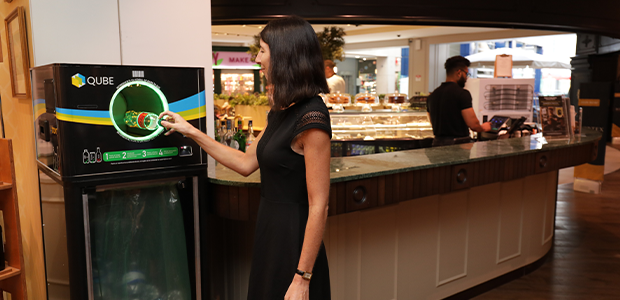
Trovr, a recycling technology startup transforming how the world manages single-use drink containers, has launched the QUBE in the UK – a smart recycling unit designed to offer independent retailers support with the upcoming Deposit Return Scheme (DRS) without the cost, complexity, or footprint of supermarket-scale systems.

Deeptech and life sciences startups that have spun out of Europe’s universities have a combined value of $398 billion and an increasingly influential position in the region’s technology ecosystem, according to a major new report.