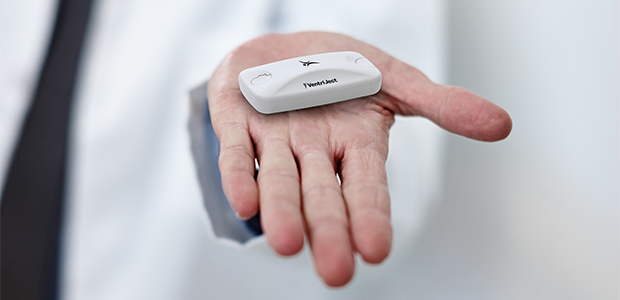
A Danish medtech startup behind a technology that accurately measures cardiorespiratory fitness (CRF) has just closed a €1.7 million funding round following expansion into several European markets.

NineSixteen Studios is the latest venture launched from cocreatd. Founded with Ben Kaluza, one of the UK’s leading tech content creators (900k followers), and serial entrepreneur Jono Fereday, NineSixteen Studios helps tech companies produce premium creator content that people actually want to watch.

Wave Photonics has announced the launch of its PDK Management Platform to integrate foundry PDKs with EDA tools, provide ready-calculated S-Parameters for circuit simulation, and provide easy access for designers.

Tide has become the first UK provider of business cards to remove printed numbers from its cards – eliminating its own exposure to several major types of card fraud that rely on visible card details.

Definely, an AI-powered legaltech company that enables lawyers to efficiently and accurately review complex contracts, has launched ‘Cascade’. The product detects and tracks the ripple effects of changes across entire contracts, helping improve document quality, reduce risk, and streamline drafting and review workflows.

Riva Money, the global payments firm using blockchain technology to streamline the movement of money, has raised a pre-seed round from Project A as well as angels from Revolut, Monzo, and J.P. Morgan. The $3 million round will be used to solve the persistent pain points of global money transfers.

Across Sub-Saharan Africa, Micro, Small, and Medium sized enterprises (MSMEs) are responsible for nearly 50% of the region’s GDP. Yet, despite their economic importance, access to capital remains a persistent challenge. For many of these companies, the financial tools needed to scale and innovate remain unjustly out of reach.

The CIPD reports competition for well-qualified talent increased over the past year, with over half (56%) of organisations experienced retention challenges. With the battle for talent heating up, small and medium businesses (SMBs) find themselves competing for the same talent as big enterprises – turning to their playbooks to give themselves an edge.

As a founder in a business built on human connection, the rapid rise of AI can feel overwhelming. Without AI, could our businesses become obsolete? Does my human-centric approach still have value in an increasingly tech-driven world?

As a startup entrepreneur, the journey to becoming an iconic leader is not about following the crowd, it’s about embracing your uniqueness, leading with authenticity, and strategically positioning yourself for success.

While the UK’s skills shortages have persisted during the last few years, recent data has revealed a promising improvement. Skills shortage vacancies fell from 36% in 2022, to 27% in 2024, according to the Department for Education’s latest Employer Skills Survey.

Close Brothers Invoice Finance has launched a new team – called ‘Scale Up’ – to help support startups and smaller SMEs with facilities up to £350,000, and prepayments of up to 100% to maximise liquidity from day one.

A growing number of UK businesses are on the brink, with a new report examining workplace productivity in small and medium enterprises (SMEs) revealing that one in five businesses nationwide say they are operating in or near survival mode.

New data from the British Business Bank’s Start Up Loans programme, which provides finance and support to start up and early-stage businesses, shows a year-on-year increase in the value of finance being accessed.

Belgian spacetech startup EDGX has closed a €2.3 million seed funding round to accelerate commercialisation of EDGX Sterna, a next generation Edge AI computer for satellites.

Three pioneering healthtech companies are set to accelerate their growth and market impact thanks to investment from STAC, Scotland’s accelerator for smart, connected, and deeptech startups.

American author and cultural critic, Neil Postman, once observed that even if the available technology of an age means you can do something, it doesn’t necessarily mean you should do something. Fundamentally, his argument asks whether progress for progresses’ sake is actually always beneficial to society.

Global healthcare systems are at a breaking point. A global pandemic, economic volatility, and global political shake-up have created an environment where healthcare cannot thrive. Adding to this, we are facing a large aging population that is being cared for by a shrinking workforce, creating huge fiscal tension.

Discover how eco-conscious startups are reducing costs and emissions with smarter packaging, tech-led warehousing, and efficient delivery strategies.
Ask a founder about their business finances and you’ll get burn rates, runway projections, and real-time dashboards. Ask about their personal finances? Crickets.