

Augment Aero: automated airside assistance


Augment Aero is a company focused on innovative aircraft maintenance by using AI and AR to enhance efficiency and safety in the aerospace industry – and they’re doing it well.
Founded in 2023 by Elaine Harding, the company is focused on saving airlines big money and increasing safety by using technology.
Harding has been working in the aviation sector for 10 years, but until her journey to founding Augment Aero, she was firmly on the business side of the operation. Initially working as an aerospace recruitment consultant at a large corporate company, she then went on to run her own aerospace consultancy. From there her business flourished, and it got her to thinking what else she could do.
Moving onto the runway
Harding was in a co-working space when she noticed someone using augmented reality (AR) technology for the construction industry.
“That got me thinking that there are applications for aviation and that this could be really useful for engineers because there are so many use cases.”
Feeling confident in the applications this could offer, Harding began applying for funding.
Thinking that the first thing she needed to do to get her idea going was to get funding, she applied for grants – and each one got rejected.
“I listened to the feedback and they each said that ‘you’re a recruitment consultant. You’re not an engineer’. I got so much pushback from declined grant applications – but I realised a lot of that was actually the art of writing an application.”
Cleared for take-off
A breakthrough moment came when Harding was speaking at an event and she realised she was sat next to Dame Wendy Hall – the first female contributor to the Internet.
“She’s a worldwide AI queen, and I was sat next to her. So I asked her, ‘can I talk to you about aerospace?’”
They’d agreed to a zoom call and four months later, Harding was speaking to Dame Hall once more. Unfortunately, Dame Hall told Harding that she was unable to advise individuals on AI. At that point, Harding spat out what she said she could only describe as an elevator pitch.
“Some ideas just came out of my mouth, and within a few minutes she was emailing people at the university [of Southampton] because she realised that she could help me.”
The next thing Harding knew, she was set up at the university with a group of student engineers.
“I was sat with five machine learning students, talking about ideas and creating prototypes. It was going so well that the University of Southampton said that we can apply for a £1.2 million grant.”
However, there was a caveat. Harding had only four days to apply and she needed one customer. Leveraging her contacts, she began making calls and within four days they didn’t just get one customer, they got four product partners that were going to trial and test the product in early focus groups.
“Christmas time 2023, I get this email saying I’ve won a £1.2 million grant … the caveat of the grant however, is that you have to spend the money first and then claim it back.”
Harding began applying for funding once more, but this time she had more leverage to pitch her idea …
Crosswinds
Despite having the offer of a grant, a design team, and Dame Hall in her corner, raising funds was, again, much more difficult than Harding had anticipated.
“The beginning of January 2024, I wander out into VC land … with no code but a grant application approval. Little old me, who is a recruiter and not a techie at all – who just works in commercial aviation. I got so many ‘no’s’ … I felt like an alien walking around.”
Harding recalls that at one point she had received so many rejections that she sat on her office manager’s floor and just started to cry.
“I told her ‘I don’t think I could do it’ and she said ‘Well, until they take that grant away from you, you have to keep trying because the universe has literally given you a £1.2 million grant.’ So I kept going.”
Harding met another potential investor on the day of the Boeing trial, where it was reported that Boeing had lost £1 billion off its Cap Table.
“I had a meeting with an investor, and by that point I had given up. I thought, this is too hard. I said [to the investor], ‘look, you can see on the news, this issue has cost Boeing a billion pounds today’ and that, along with my pitch and due diligence, was impactful enough and we got the investment. Fast forward to now – we have the code and we’ve just signed a development partnership with one of Europe’s largest airlines – watch this space for exciting announcements.”
Approach
The grant and investment meant that Harding was now able to hire a quality team of engineers.
“We now had Dame Wendy Hall who was backing us from an academic perspective. We had a guy who had previously run hangers for TUI and British Airways contribute to the aerospace side. Then we had another AI person. Plus a whole team ready to press ‘go’. It was because of the government grant that we could employ people at such a high standard from the get go.”
A touch of flare for airside safety
When asked what Augment Aero actually does, Harding says it’s quite futuristic and she usually has to tailor her reply depending on her audience.
“We’re innovating aircraft maintenance, but we’re incorporating AI and AR, so we are niche, but in really big areas.

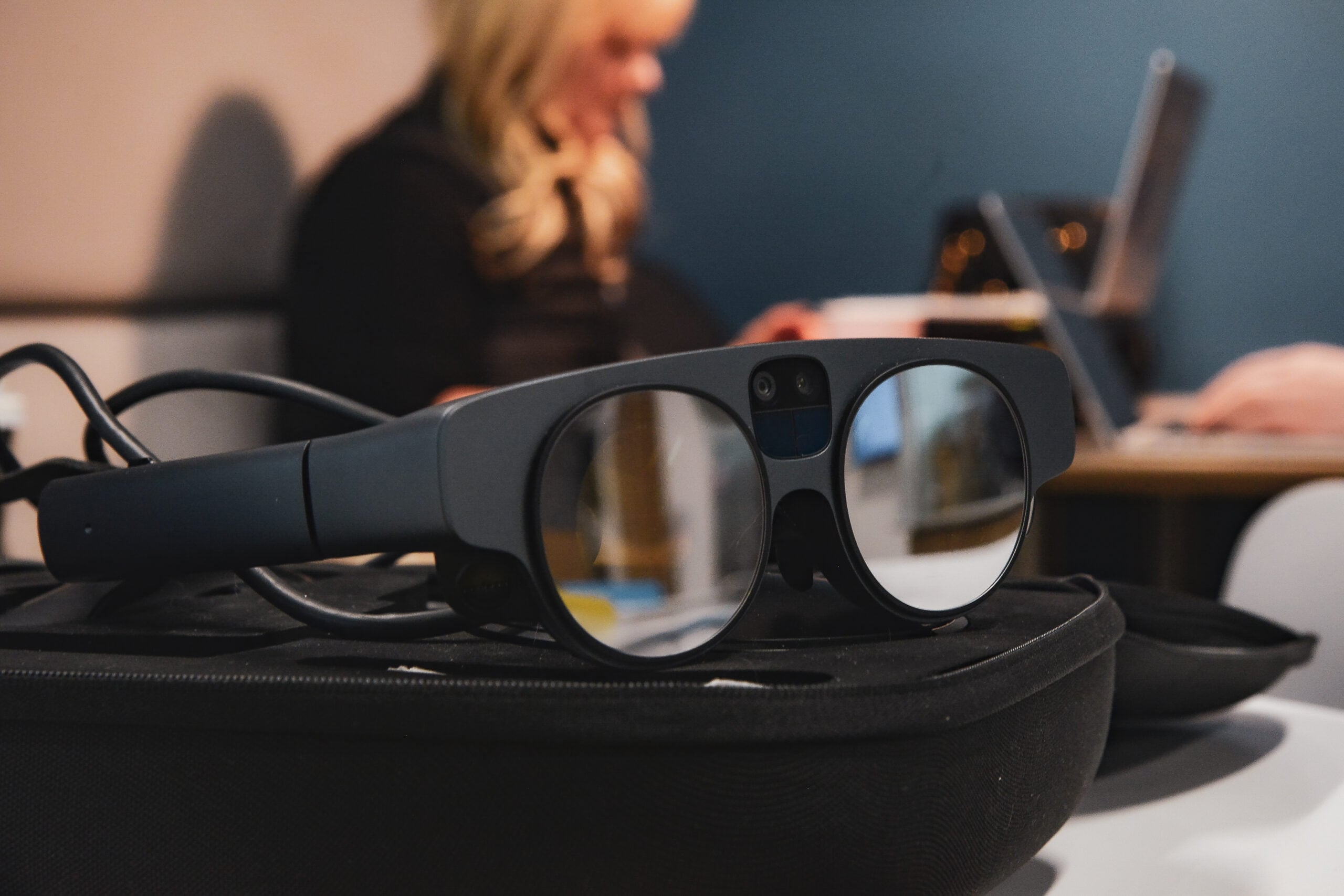
“The best way I describe it is like the Iron Man movie. Tony Stark has Jarvis – it’s kind of like that … we’re making the day to day admin tasks, that engineers might spend up to two days on, automated. What that means is, if you’ve got a pair of our VR glasses on, that is helping the aircraft engineer monitor what they’re doing, and then cross-reference the manual so they can have overlays.”
This simple yet effective way of approaching aircraft maintenance not only helps the engineers do their jobs more efficiently, it also empowers them with the information they need, when they need it.
“I’m personally super, super passionate about empowering engineers with extra tools – because no one wants to make a safety critical error. People should be protected by AI in this way when it’s available to them.”
Maintaining maintenance
There are several challenges around aircraft maintenance that cost airlines millions of pounds.
“The issues around aircraft maintenance are that there isn’t enough time for aircraft engineers to do what they need to do. There aren’t enough people doing it. During COVID-19 everyone left the industry and [started] working from home, so getting them back is difficult – and the industry is growing so significantly that there’s just not enough engineers. And processes are fairly inefficient because there are so many layers of safety paperwork to go through … we’re empowering engineers with information, so that if, God forbid, they make a mistake, it means the technology will alert you in real time.”
From deeptech to big savings
A particular highlight for Harding is the realisation that, from an idea born at a co-working space, she now sits talks to the world’s biggest airlines about the idea. One standout moment for her is when she talked Ryanair through all the possibilities of the technology.
“Sitting in a room with Ryanair executives and getting them excited about the potential of the technology was really special. Especially when it’s an organisation all about efficiencies.
“So we sat down and we worked out for the Ryanair fleet that if we were able to save them one day of engineering – because let’s say an aircraft is out for 10 days each year for engineering – that gives them around £54 million in revenue – because of the size of its fleet. Having that availability of the plane to go and generate revenue and to do more flights, reduce cancellations, reduce delays all has an impact on the bottom line.”
Reaching your destination
Harding said that the company’s AR glasses will eventually be able to detect fatigue in engineering teams, and if an engineer has been pushing themselves beyond the limit of what they should be doing.
“The more data points you have, the better a process can get. And in a safety critical environment like aerospace, that information is absolute magic. We want to know when people are fatigued, so that we can be the safest industry out there.
“But it’s also about supporting engineers to make sure they’ve got all the right information available to them at the exact moment they need it.”
The next thing for Harding and the team is to focus on getting the product as good as it can possibly get – which means streamlining the product market fit by going on site, sitting with the engineers, and getting the products in operational use in a large airline.
Harding says that the company has a funding round open for EIS investors.
If you’re interested in investing in a fun and innovative company – get in touch with Elaine at: elaine@augmentaero.com
