

Phytoform: sowing the seeds of smarter agriculture

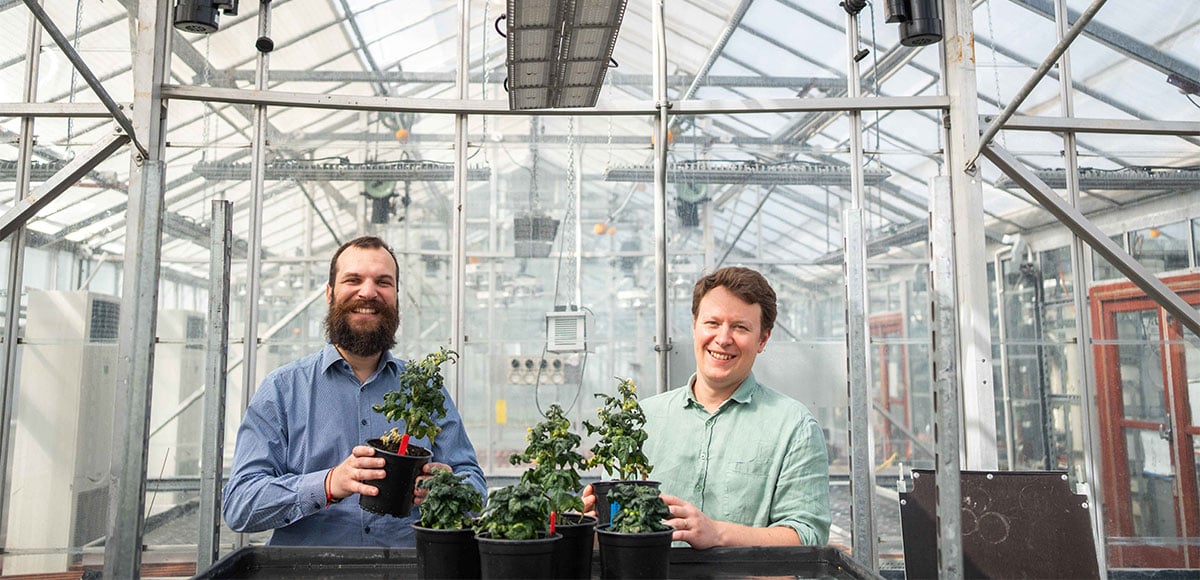
Phytoform Labs is on a mission to improve the sustainability of agriculture and create future-proof crops through the power of genome editing and AI. “We are not a typical database or coding company. We are an agricultural company, or, more specifically, a genetics company, and we work on agricultural solutions,” explained Nicolas Kral, Co-Founder and CTO, Phytoform Labs.
Kral’s background lies in plant sciences, as a trained plant scientist. “After my doctorate, together with my colleague and co-founder William [Pelton], we have been developing technology solutions where we work on the hard challenges in agriculture, especially focused on improving the seeds and the actual produce itself.”
THE TECHNOLOGY BEHIND THE STARTUP
Phytoform Labs has created a platform that combines computational insights, heavily relying on AWS’ platform to run it, and a laboratory component where it uses precision breeding tools.
Kral described: “These are novel technologies on how to improve seeds and make seeds better. We glued together these two really powerful technologies, both Cloud computing AI as well as precision breeding to make plants better.
“We are focusing on improvements in shelf life, improvements against diseases, so the plants can be really resistant, and you can use less fungicides and pesticides. So, this is really what the technology is, and the products that we are producing are great.”
Current methods to improve crops are severely limited by time, plant diversity, and ultimately, cost. Phytoform’s solution can produce new plant traits in months, rather than years, and is a fraction of the cost of conventional breeding and GMO technologies. The plants are often smaller, taking up less arable land, with high yield harvests.
Phytoform uses a proprietary predictive biology approach called CRE. AI.TIVE to redesign and prove novel patterns of gene activity for target genes. It uses a sequence-to-expression modelling algorithm, to predict gene activity across tissues and conditions. Together with simulated mutations, it creates large promoter libraries to achieve novel gene expression patterns, and screen and validate these libraries with high throughput expression testing in plant cells.
The outcomes are fine-tuned promoter variants that enable native and tissue/condition/temporal-specific overexpression. This allows Phytoform to modulate gene activity and provide novel functional native traits.
Phytoform is known for its innovations in tomatoes and potatoes, however, this is not it’s only mission. “So we are really a platform provider. We provide blueprints on how to improve plants, or the varieties themselves, for companies that don’t have their own biotech capabilities. We can provide end-to-end solutions, and for that, we work on tomatoes as well as potatoes.
“Tomatoes and potatoes are really what we are developing end-to-end. We have developed a solution for potatoes, that has been grown in the UK already. It is still in the research trial phase, but we’re looking to commercialise that initially in the US, and then hopefully in the UK too.”
Phytoform has publicly announced a pilot partnership with Corteva, the second-largest corn seed company in the world. “We’re not actually developing the corn. They are developing corn, but we are providing tech solutions for them.” Kral explained that he can see Phytoform partnering with other agricultural companies to provide solutions on the technology front. This extends to the large global corporates, to smaller companies that may decide not to venture into the biotech space, where Phytoform can then provide the end-to-end solution.
“I think we will stay focused on tomatoes and potatoes, and for the wider agricultural space, we will work more on the AI computational side.”
THE IMPACT OF THE TECHNOLOGY
Agriculture is a large contributor to greenhouse gas emissions. In the UK, 10% of all greenhouse emissions are from the agriculture sector, and worldwide, it is estimated that up to a quarter of all greenhouse gas emissions come from the agricultural sector when including land-use. Phytoform’s solution allows for more climate-resilient crops with a smaller carbon footprint.
“The last few years have really shown just how important food security is, and with geopolitical problems like the Ukraine war really upsetting prices of global commodities around the world, it’s really important to have seeds that can withstand stress and that can produce under non-optimal situations.
“Additionally, we have changes in labour flow. Especially in the UK after Brexit. Labour that used to be available for farmers is not there. So automation becomes much more of a relevant issue for how to sustain food security in the UK, especially where this is going to be an ongoing challenge.”
Not only this, but the importation of food, when countries are able to produce it themselves, is a growing factor in supply chain instability as well as greenhouse gas emissions.
“85% of tomatoes in the UK are imported from abroad, but the UK can grow its own tomatoes. There’s no reason why they don’t. And actually, the Isle of White tomatoes are really great. So this is where we see the technology going. With climate change, with the food security, with geopolitics creating concerns, but also new opportunities.”
GROWING PAINS
“There’s been many challenges on the technology front. We have had to conceptualise a platform that didn’t exist before,” Kral said, discussing the challenges on the Phytoform journey so far.

Luckily, the team that makes up Phytoform has become its backbone, and the reason for its success. “We’re really lucky that our team is an ensemble of the best experts in plant molecule biology, but also in data science, bioinformatics, and thanks to AWS, they’re becoming Cloud computing experts too. So they’ve been our rock in being able to get over these challenges.”
However, there are some challenges that have been more difficult to solve. “In agriculture, a lot of it is regulation based, so overcoming regulations and having clarity on what we can commercialise and where is probably the biggest challenge for the precision breeding sector. These supply chains, they are multinational. A lot of the times things are produced in one country, and they go to another. You really do need cross jurisdictional compliance, and that is difficult with some of the newer technologies that we’re using.”
FULLY BLOOMED
With challenges come the highlights, and for Phytoform, these are the fruits of its labour. “The biggest highlight probably is when we get visitors and they get to eat our tomatoes.
“When you see plants growing, and you can point at the feature that you’ve designed. We have the benefit that as a business, we’re not just in code and software, but we actually work with the real world. So eating your own outcomes is nice.”
Kral also continued to emphasise the team and their importance to the mission: “Having a small team of 20 people being able to get biotechnological innovation out there is a huge highlight for me, and it really makes it real.”
WHAT’S NEXT?
The startup has already proved that the technology works, so what is next for Phytoform?
“We’re now really excited about looking for scaling up our approach to work with more partners.”
Working with the real world means the impact can be seen, and this is what Phytoform want to do more. “Just being able to actually get the seeds into the hands of farmers, that will be exciting.”
This article originally appeared in the January/February 2026 issue of Startups Magazine. Click here to subscribe
