

TRIC Robotics lights the way for chemical-free farms

The agricultural landscape has evolved over the years, but as a sector, it is still seen as very traditional, with little innovation happening. However, the sector is transforming. Agricultural problems are requiring modern solutions, and high-tech solutions are being utilised in the field to improve efficiency, sustainability, and yield.
“I found agriculture while looking for a big problem to solve that could help a lot of people. I wanted to do something truly valuable for the world. Agriculture stood out to me because it impacts everyone and has very practical challenges such as labour shortages, rising input costs, pesticide resistance, and increasing pressure to produce food more sustainably,” explained Adam Stager, Founder and CEO of TRIC Robotics. “It was the perfect place to solve exciting problems and also where automation could make new solutions possible.”
Stager’s background sits in engineering and robotics, with a specialisation in “inventing new things that solve real-world problems.” And solving a real-world problem is exactly what his startup TRIC Robotics has done.
Demand for organic produce is rising, driven by health concerns and a desire for less processed and chemically-treated foods. TRIC’s work is helping farmers grow food more sustainably by making nonchemical crop protection practical, reliable, and economically competitive.
Stager delved into this: “Farmers are being asked to reduce pesticide use while continuing to produce more food with fewer resources. We want to give them tools that make that possible without asking them to sacrifice yield, quality, or profitability.”
Tric Robotics
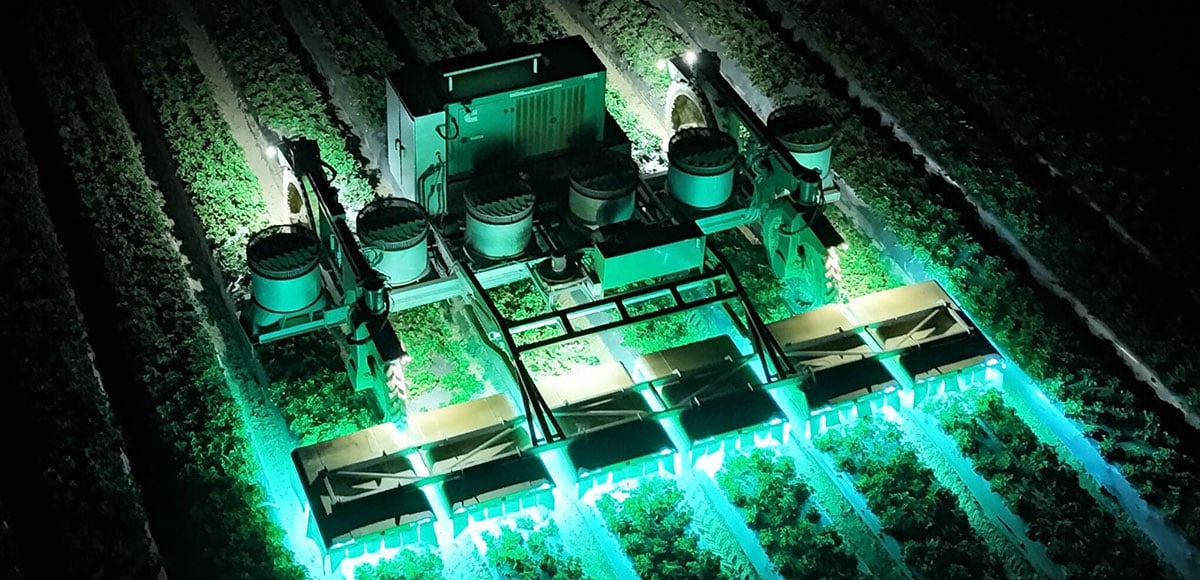
TRIC Robotics has developed tractor-like robots that operate autonomously through fields at night, treating crops with UV-C light and other nonchemical tools. “At TRIC we believe in building with our customers. We spend a lot of time on the farm truly understanding the problems that farmers face with deploying new technology,” Stager said. “Farmers have seen a lot of technologies that looked impressive in a demonstration, but these machines need to work in real-world conditions, so that is where we design and test them.”
TRIC is currently focusing its offerings for strawberry farms, a decision made due to being a high-value crop with significant disease and insect pressure.
The Luna robots can treat multiple rows at once, and can carry TRIC’s high-powered insect vacuums that suck up the bugs that can’t be treated with light. UV-C can control diseases that plague crops such as mites, mildew, and mould by preventing the pathogens from replicating and the eggs from hatching. Operating and applying the technology at night-time is particularly effective as many of these organisms use sunlight to repair damage during the day.
Stager explained the use of UV-C in agriculture: “The science behind UV-C was originally developed for over a decade at the United States Department of Agriculture (USDA) where scientists studied how the light interacted with both the plants and pests. It made a lot of sense in the lab but was difficult to apply with the uneven terrain and environmental conditions on real farms. It needed to be delivered repeatedly, consistently, and at night which made field-scale trails challenging. It was the perfect fit for automation.
“The robot could enable an entirely different method of crop protection that otherwise would not be commercially feasible. It also unlocked the nightshift which has allowed us to spread the work over more hours of the day and increase overall productivity.”
Ultimately, TRIC plans on using these robots to deploy many new technologies on the farm. Relationships with customers have been key in building and scaling TRIC. Stager said: “We took the approach of scaling with a few large customers first rather than scaling on many small pilot-sized ranches. This forced us to make sure our machines could run reliably at commercial-scale and meant that they had to provide enough value for farmers to commit a meaningful portion of their entire crop protection budget. Farming technology spreads by word of mouth, so scaling on full farms made it much easier for new customers to trust our team and the technology.”
Servicing, not selling
TRIC operates a robotics-as-a-service model, a decision shaped by the needs of the farmers it aims to serve. Stager explained how they worked closely with farmers to understand the best way for them to pay and the best way for TRIC to have a scalable business.
“We realised fairly early that most strawberry farmers typically pay for sprays per acre per application, so we came up with a similar business model,” Stager explained. “Selling the robot would also require farmers to take on the capital investment, training, transportation, maintenance, software, and technology risk. With our service model, we take responsibility for all of that while also learning and improving much faster than if the farmers operated the equipment themselves.”
A farmer can hire TRIC to treat a certain number of acres on a regular schedule. TRIC then transports the robots to the farm, maps the fields, operates the equipment, monitors performance, and provides treatments throughout the season. The machines are designed to fit on the farms of today, rather than for the tech-enabled farms of the future, so farmers are able to get started straight away.
Although Stager did mention that in other crop farming applications outside of strawberry farming, it may make more sense to sell machines, develop tractor mounted implements, or develop smaller models. Focusing on the strawberry market, this isn’t a current consideration, however as the startup begins expanding into new markets, “the most important thing is to listen to the customers.”
Impact
When it comes to farming and agriculture, the impact of technology is huge, not only for the farmers and agricultural workers, but the consumer too. Stager explained: “The most direct impact is reducing reliance on chemical pesticides while helping farmers maintain or improve crop quality and yield. We believe in a future where innovation can help farmers grow healthier, lower cost food without damaging the environment. That means less chemical exposure for workers, fewer residues, less chemical runoff, and more resilience to our food supply.”
The impact isn’t only relating to health, but wealth. “Farmers are facing rising labour and input costs, and many specialty crops are becoming increasingly difficult to grow profitably. Automation can help keep those farms competitive and help preserve agricultural production in regions such as California.”
Enabling more technology in the agricultural sector can have a big impact on the future of the sector, especially as farming is on the decline in many countries due to related costs.
The challenges
“One of the biggest challenges was demonstrating our solution on a commercial scale,” Stager explained. “It was a huge leap to go from small robots and acres to large commercial deployment because it depended not only on our ability to scale our machines, but also the willingness of farmers to commit massive acres.”
Stager explained that this was difficult to overcome, but was made easier by the relationships TRIC built with customers. “We have overcome that by spending a ton of time in the field. Each step scaling to larger acres and building more trust with our customers. We have redesigned components, simplified systems, improved our operational processes, and built a team that understands both robotics and agriculture. Now we are at an exciting inflection point where the value is clear and has been demonstrated on full farms, so farmers are calling us faster than we can build robots.”
The funding journey hasn’t always been smooth. From starting in a garage and winning small pitch competitions, to securing grants, bootstrapping the first tractor-scale robots, bringing in angel investors, and most recently, venture capital to scale the business.

While funding is not the easiest of journeys, Stager admitted “we have been lucky to find investors who are extremely aligned with our mission and are as supportive of the people as they are of the business.”
The fruits of the labour
One of Stager’s personal highlights has been being thanked by a farmer. “Up until that moment I had a lot of doubt. Will it work? At the end of the season I went to thank the farmer for helping us run an early pilot and he genuinely thanked us for helping make his season great. That was really inspiring.
“Now the farmers who work with us make us promise that we will have a robot for them. Some of them even say that they can no longer grow without the machines. That is a really exciting thing to hear from customers,” Stager said.
It isn’t just the positive feedback that keeps TRIC running. The team Stager has surrounded himself with has made the startup into the business it is today. “I am proud of the team we have built. Operating autonomous robots at night in active agricultural environments requires a lot of grit, late nights, and problem-solving. Every major milestone has come from the team being willing to go into the field, do hard things, and keep improving the system.”
Rooting for the next chapter
“Long term, we believe farms will use fleets of autonomous machines that perform many different jobs throughout the season. Crop protection is our starting point, but the broader vision is to create a platform that allows farmers to use automation across a wide range of operations,” Stager explained. While TRIC is currently focused on strawberry farming, the technologies that the startup has developed can apply to many crops. In the long-term, TRIC is looking at expansion. “We plan to start in specialty crops and to focus first in California, so we can keep our team close to our customers. Many existing customers also grow other crops like raspberries, blackberries, and leafy greens, so those are areas where we can expand quickly with trusted relationships.”
And this expansion isn’t just to other crops, but new technologies too. “Now that we have robots on the farm, there are also incredible opportunities to leverage automation to add more value beyond crop protection. In the same way that we added bug vacuums to help with pests that light doesn’t control, we are excited to add new technologies to our robots to help increase the profitability of our farmers.”
With more demand than machines at the moment, the startup is expanding the fleet, deploying them, and scaling the organisation to support more acres and customers.
“The core business will become the foundation for something much larger. Our long-term goal is to build a globally impactful agricultural innovation company, using the technologies we are building and customer relationships to expand into new capabilities, new crops, and new markets.”
The future of agriculture is tech-enabled, and TRIC Robotics is well placed to help farmers into this new era of farming. “At scale, our goal is to treat millions of acres using nonchemical methods and to become a global agricultural innovation company. I would like TRIC to demonstrate that sustainability does not have to be a cost but instead can make farmers more profitable. With the right technology, it can improve both environmental outcomes and farm economics,” Stager concluded.
This article originally appeared in the July/August issue of Startups Magazine
