
A growing number of UK businesses are on the brink, with a new report examining workplace productivity in small and medium enterprises (SMEs) revealing that one in five businesses nationwide say they are operating in or near survival mode.

New data from the British Business Bank’s Start Up Loans programme, which provides finance and support to start up and early-stage businesses, shows a year-on-year increase in the value of finance being accessed.

Belgian spacetech startup EDGX has closed a €2.3 million seed funding round to accelerate commercialisation of EDGX Sterna, a next generation Edge AI computer for satellites.

Three pioneering healthtech companies are set to accelerate their growth and market impact thanks to investment from STAC, Scotland’s accelerator for smart, connected, and deeptech startups.

American author and cultural critic, Neil Postman, once observed that even if the available technology of an age means you can do something, it doesn’t necessarily mean you should do something. Fundamentally, his argument asks whether progress for progresses’ sake is actually always beneficial to society.

Global healthcare systems are at a breaking point. A global pandemic, economic volatility, and global political shake-up have created an environment where healthcare cannot thrive. Adding to this, we are facing a large aging population that is being cared for by a shrinking workforce, creating huge fiscal tension.

Discover how eco-conscious startups are reducing costs and emissions with smarter packaging, tech-led warehousing, and efficient delivery strategies.

Ask a founder about their business finances and you’ll get burn rates, runway projections, and real-time dashboards. Ask about their personal finances? Crickets.

Alibaba.com announced that CoCreate Pitch, a product-focused pitch competition, has received over 20,000 submisisons ahead of its first application deadline on 15 August.

Sânziana Foia is the Founder and CEO of Papcup, and she is on a mission to give women across the globe autonomy over their own bodies – by giving them freedom and choice when it comes to how and where they have their smear tests.

Chronic Obstructive Pulmonary Disease (COPD) is the name for a group of common lung diseases, and it is one of the major challenges in respiratory healthcare. According to the World Health Organization, COPD was linked to 3.5 million deaths in 2021 and is the fourth leading cause of death globally, while in the UK, it contributes to approximately 30,000 deaths every year.
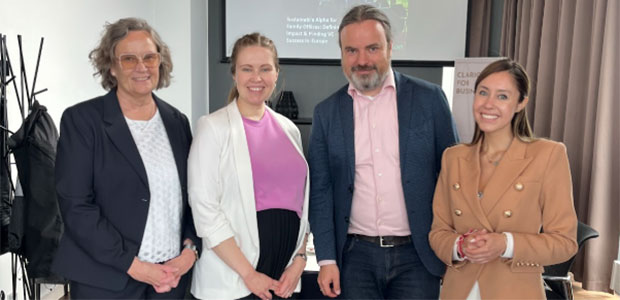
Family offices worldwide manage about $10 trillion in wealth. According to a 2024 FVCA (Finnish Venture Capital Association) survey, the third largest allocator of capital to local (Finnish) venture firms (right behind national funds and pension funds) is family offices.

Patchworks, the UK-based integration platform powering composable commerce for high-growth brands, has announced 36% year-on-year recurring revenue growth with continued international momentum.

As businesses ramp up their AI investment, technical capabilities alone won’t guarantee success, warns new research from Multiverse.

According to iData research, in 2023 alone, 15.2 million laparoscopic procedures were performed globally, while the Royal College of Surgeons of England cite that in the UK, 60,000 gall bladder removals are performed annually, but given the scope that laparoscopic procedures cover, this number is likely to be much higher.

In the evolving landscape of digital entrepreneurship, few stories resonate as powerfully as that of Amman Ahmed, Leeds-born founder of Music For Pets. Launched in Manchester, UK, Ahmed’s journey began with a simple mission: to transform pet wellness through audio.

New data from the British Business Bank’s Start Up Loans programme, which provides finance and support to startup and early-stage businesses, shows a year-on-year increase in the value of finance being accessed.

Tracelight, the UK-founded AI company making financial models easier to build and trust, has raised $3.6 million in seed funding.

Today’s world of work has evolved well beyond the days when permanent, full-time employment was the archetype of workforce planning. The focus has shifted from maintaining fixed employment structures to building flexible systems that can readily absorb skills and talent on demand, unbound by geographical boundaries.

From the very first day my co-founder Jorge and I founded Abacum back in 2020, we knew unequivocally that the US market was our K2, which needed conquering. Today, more than half our revenue stems from here and it’s our fastest growing market.