

TrovrQUBE gives recycling a return on investment

Sheryl has trained in proofreading and copyediting with the College…
Sustainability is not short of attention nowadays. Yet, when it comes to recycling, for many consumers and retailers, there can be a disconnect, and best practices can feel either inconvenient or unclear. Deposit Return Schemes (DRS) promise to change that, but they also bring in new challenges – particularly for independent retailers. Trovr believes it has found a way to make the transition simpler, more engaging, and commercially viable through its compact smart recycling unit – the TrovrQUBE.
Founded by self-confessed “serial entrepreneur” Nick Yeatman, Trovr is a recycling technology startup that is tackling how single-use drink containers are collected, returned, and valued. Its TrovrQUBE flagship product is designed to support independent retailers as the DRS comes into effect across the UK and Europe in 2027, whilst also encouraging consumers to rethink how and why they recycle.
FROM BACKSTAGE TO BOTTLE BANKS
Yeatman started his career in the music world before moving into finance and spending time in Formula One. Yet, despite the diversity of his career path, a thread continued to run through his professional journey, and that was a persistent urge to create, combined with an increasing need to do something that mattered.
To make a positive, meaningful impact in the world. Especially when it came to the environment.
“I wanted to do something more meaningful … I wanted to have a positive impact, and like many people, I care about what happens to the environment – it’s scary and worrying,” he said.
However, it was only during his visits to India that his concern became more tangible. Seeing the country’s large-scale pollution was a turning point. This pushed him to look more closely at recycling and waste systems.
“When I came back [from India], I thought that if, in some way, I can make a small dent in this or be part of the solution for it, then that’s a good thing.”
Yet, profit and purpose are not always synonymous, particularly in sectors where infrastructure costs are high and behavioural change is slow. This disconnect is the space that Yeatman set out to solve with TrovrQUBE.
CATCHING BOTTLES THAT FALL THROUGH THE CRACKS
The focus for the company is to reach the groups of people who aren’t actively thinking about recycling, or who see it as an inconvenience rather than a habit.
“I’m not chasing down the people who are already engaged in environmental challenges … I chase the people who are not in the room yet. We use incentives to bring them into the room and then hopefully change their hearts and minds without badgering them. We hope to open up a different view on how to live a more circular lifestyle.”
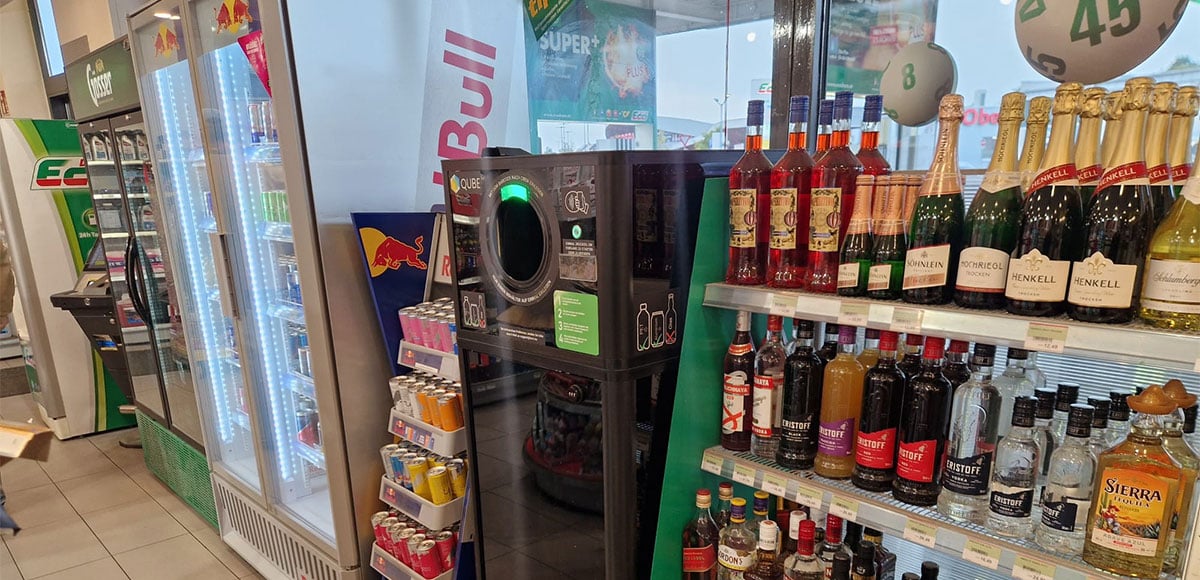
To this end, Trovr’s business model is a hybrid that blends marketing, manufacturing, and software design. The TrovrQUBE sits at the centre of this model. It is a compact, affordable recycling machine designed primarily with independent retailers in mind.
“Traditional reverse vending machines are big, and they’re expensive. We had to go away and make a product that fits in the gap. Everything is designed to support manual collection recycling (for independent retailers who don’t have big budgets).”
Once the DRS is rolled out, many small retailers will find themselves in the unenviable position of having to invest in large-scale reverse vending machines or manage returns manually, often using plastic bags with limited space. The TrovrQUBE sits in the gap between these two extremes.
“It fits a certain shape and design, and it’s considerably cheaper … Nobody had made a product like this on the market before. This is where I thought, ‘we get to be disruptive here. Let’s try something different’.”
Despite originally being designed for independent retailers, the product has also caught the attention of larger convenience retail chains.
MAKING DRS ADD UP
The TrovrQUBE is designed for simplicity and reliability. It scans and weighs bottles to verify they are empty before issuing either digital or paper tickets that can be redeemed for deposit returns. This reduces complexity, yet it still provides the traceability and verification required under DRS frameworks.
The unit itself is made from recycled plastic and is lightweight and mobile, allowing it to be used across a wide range of retail environments without necessitating any structural changes.
However, the most important thing is simplicity – both for the consumer and for the retailers.
Alongside the hardware, the company has also developed a digital ecosystem that supports both sides of the transaction. Consumers can download an app that incorporates loyalty schemes and digital payments, and it even has the option to send deposit returns directly to bank accounts, charities, or other recipients. Retailers, meanwhile, have access to a merchant app that provides detailed data analytics, helping them to understand usage patterns and engage customers more effectively.
It also comes with an optional 24″ video screen, which adds another layer to the unit. This gives retailers a way to communicate directly with customers or to generate additional revenue through advertising.
The combination of hardware, software, and marketing capability is a clear reflection of Trovr’s aim to make recycling not just a tick box exercise in compliance, but something that is engaging and economically meaningful.
BUILDING MOMENTUM, ONE RETURN AT A TIME
Funding efforts to date have primarily been through the founders themselves and close associates, which has allowed the company to develop its product without external pressure. However, as interest grows and deployment opportunities expand, Yeatman says the business is now preparing for broader fundraising rounds to support scaling and entry into new markets.
At the core, Trovr is driven by the idea of normalising circular behaviour, using incentives and thoughtful design to make responsible choices easier rather than obligatory. Future iterations of the TrovrQUBE are already being planned, with ambitions to process a wider range of materials and expand reward options.
By aligning technology, behaviour, and commercial logic, Trovr is betting that recycling does not need to rely on guilt or obligation. Instead, it can offer a return that makes sense for consumers, retailers, and the systems that support them – ultimately aiming to shift both industry and societal norms toward a greener future.
This article originally appeared in the January/February 2026 issue of Startups Magazine. Click here to subscribe
