

98% of startup leaders believe communications can accelerate fundraising, yet only 35% use it that way


Generative AI has made it easier for startups to produce more content, more pitches, and more investor updates. It has also made much of that communication sound the same. For founders competing for attention, the scarce asset is no longer content. It is credibility.
That is the clearest finding from Wonders and Blunders of PR & Communications in the Age of AI, a new WISH study, that brings together responses from more than 100 startups, from pre-seed companies to unicorns, and first-hand perspectives from around 40 investors, including Microsoft for Startups, journalists and startup ecosystem experts.
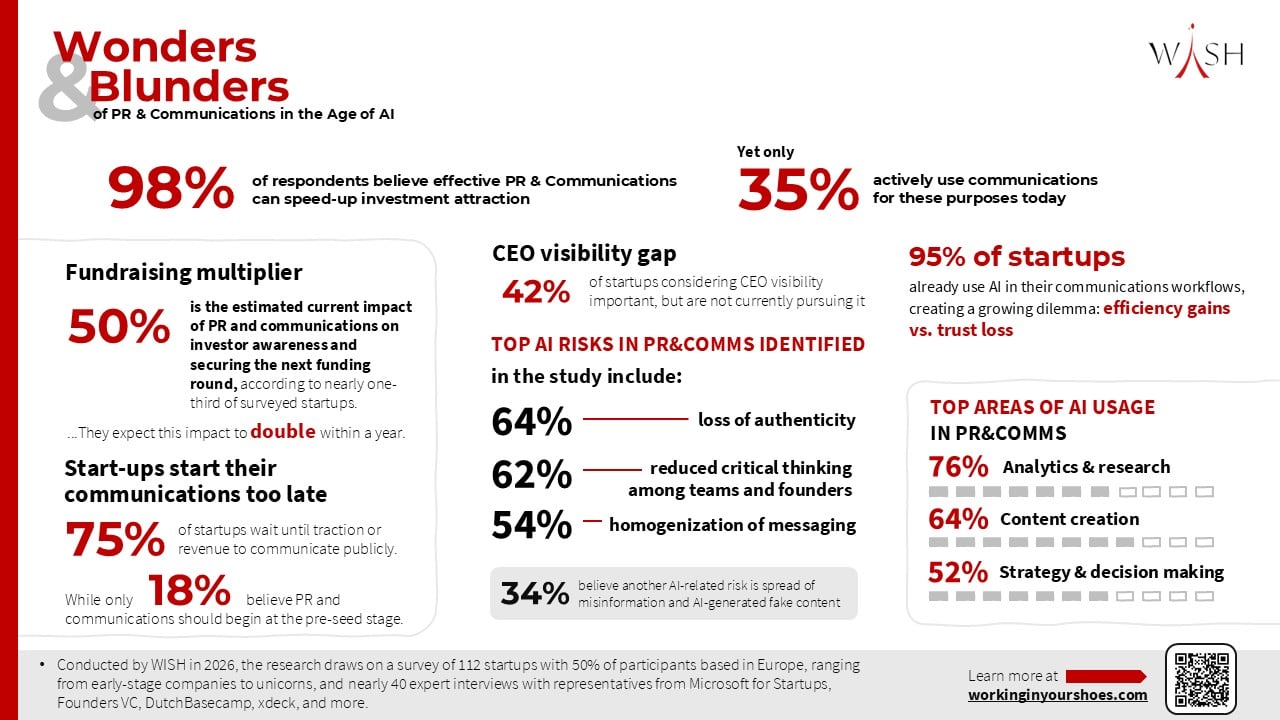
The fundraising gap is hard to ignore. About 98% of respondents believe effective PR and communications can help startups attract investment faster, but only 35% currently use communications to support that goal. Startups are still more likely to focus on brand visibility than investor awareness, even though nearly one-third of respondents estimate that communications can account for up to half of the impact on investor awareness and the next funding round.
Many startups still treat communications as output while investors experience them as evidence. A clear point of view, consistent updates and credible third-party coverage help investors judge whether a founder understands the market, can explain the company and will communicate honestly when conditions change.
“Start-ups increasingly need to communicate their vision and product direction much earlier, sometimes even in stealth mode, to pressure-test ideas and understand how the ecosystem responds. A founder’s ability to clearly articulate the product, mission, and value proposition is critical for standing out to investors, customers, and partners,” said Ran Wei Baker, Sr. Director, Marketing, Microsoft for Startups
AI cannot supply judgment
Up to 95% of the startups surveyed already use AI in communications. The efficiency gains are real, but so are the risks. Respondents ranked loss of personal touch and authenticity first at 64%, followed by loss of critical thinking at 62% and homogenization of messaging at 54%.
Ran Wei Baker, Senior Director at Microsoft for Startups, said AI can help resource-constrained startups scale their communications, but founders still need to review the output and make sure it reflects their own voice. Shaloo Garg, Managing Director for the AI startup ecosystem at Microsoft, captured the division of labor well, saying: “AI deals with 80% of the volume while humans handle 80% of the value.”
The distinction matters even more as AI agents move from assisting with tasks to participating in workflows and decisions. Garg noted that AI is strong at recognizing patterns but struggles with high-stakes ambiguity, especially when information conflicts or remains incomplete. Those are precisely the moments when a founder’s judgment becomes visible.
Start building trust before the fundraising process
The study also found that 75% of startups wait until they have traction or revenue before communicating publicly. Only 18% believe communications should start at the pre-seed stage. Investors take a different view because they often follow founders well before a formal raise begins.
Uday Khanna, Co-founder of 1406 Park Lane Partners VC, explained why continuity matters: “Communications play a crucial role in tracking how founders evolve over time. When founders keep us in the loop from day one, with regular updates and check-ins, it builds an additional layer of accountability and trust.”

That does not mean an early-stage founder needs a large PR programme. It means communicating the problem, the evidence, and the company’s progress consistently enough that investors can see how the founder’s thinking develops. A short founder update with a real insight is more useful than a polished AI-generated message that could have come from any company.
For startup leaders, the practical rule is to use AI for research, drafting, and scale, then apply human judgement to positioning, claims, and relationships. Communications should begin before a company needs coverage or capital. Trust is cumulative, and the fundraising process is a poor time to start building it from scratch.
Full report: Wonders and Blunders of PR & Communications in the Age of AI at https://workinginyourshoes.com/page239767009.html
For more startup news, check out the other articles on the website, and subscribe to the magazine for free. Listen to The Cereal Entrepreneur podcast for more interviews with entrepreneurs and big-hitters in the startup ecosystem.
