

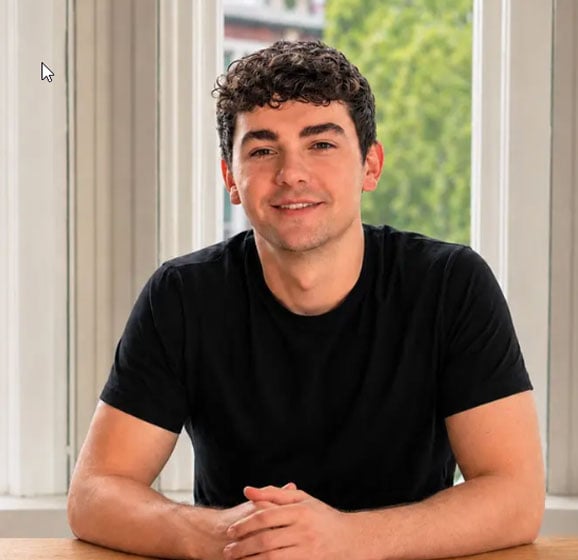
Ben Towers: inside the mind of one of the world’s most influential young entrepreneurs


When Ben Towers built his first website at the age of 11, he wasn’t thinking about business models or growth strategy. He was a kid who loved computers, teaching himself HTML by copying along with YouTube tutorials. His first client was a family friend who offered to pay him £50 and that single payment reframed everything.
“That naturally inspired [my] web and marketing agency,” Ben says, one he began treating as a genuine business by the time he was 13. “I think the way we think about what a business is, is very different these days,” he reflects. “For me, at that age, I thought to have a business, you need to have this big high-rise building … when in reality, it could be any of us making money or doing something in some shape or form.”
That agency grew steadily through his teenage years, culminating in an exit at 18. Today, Ben is the Co-Founder and CEO of Happl, an employee benefits platform operating across more than 160 countries, and he holds an MBE for services to the startup community and excellence in innovation and enterprise.
The trouble with trust
By 17, Ben had been profiled by The Times as one of “the smartest teenagers on the planet” and praised publicly by Richard Branson. It’s the kind of press that sounds like an unambiguous win, but Ben is candid that the reality was more complicated.
“To trust a teenager, or a teenager and their team, with [a big project] a big ask.” He believes being young works differently depending on the context. “I think the young card works well maybe when you’re in your early 20s, because it’s a very innovative new way of doing it. In the teen world, selling into the B2B world … I think it had challenges, which is a level of trust.”
Government policy compounded the problem. Ben couldn’t open a business bank account while under 18, which meant asking corporate clients to pay invoices into his personal account. “I’m having [to look] a customer in the eye when I’m 16 years old, who’s already thinking this kid’s young, who’s now being told, ‘Can you please pay your bill to my personal bank account because I can’t take money into a business one?'” he says.
However, Ben would go on to become the first person to secure a business bank account while still legally a minor, a change that has since made the path easier for other young entrepreneurs.
Selling the first business
Ben exited his agency at 18, a decision he says came from a mix of timing and waning enthusiasm. “I think I was losing excitement in what I’d built,” he explains. “I now realise the value of doing something you love, and that gets you through the hard times.” When a rival agency approached about an acquisition, he took the meeting, and the deal followed.
The sale taught him two lasting lessons. The first was structural: “You build a company in a very different way if you want to sell it, because you always have to have data readily available, you always have to go through due diligence.” The second was cultural, drawn from comparing UK and US attitudes to founders letting go of their companies. “In the US, they’re really on this idea of, well, we give it a go, [if] it doesn’t work, we do something else. In the UK, this is my baby. We have this really close connection to business, which they don’t have in the US at all.”
Selling forced him to separate his identity from the company itself: “The company is not my identity. My identity is who I am.”
Ben completed his six-month contractual handover and moved on to advisory work with the government on entrepreneurship and AI, before consulting for GSK on its global consumer healthcare communications.
The government work saw him sitting in on AI strategy conversations at 10 Downing Street as one of a small group of “dynamic advisors.” Discussions ranged from who should own AI decision-making within departments to the economics of data centre compute.
Alongside his AI advisory work, Ben has also spent time consulting for governments and FTSE companies on Gen Z engagement, including an extended stint working with the New Zealand government on youth unemployment and mental health strategy, spending time in local Māori communities as part of that work.
The missing piece
After leaving government-adjacent advisory work, Ben found he missed running his own company. “I lost that real, intense problem solving,” he says. “I love starting work and being told, here’s 10 things which are wrong, how can we fix it?”

The idea that became Happl started around the onset of COVID-19, with a mission to combat loneliness by connecting colleagues with shared interests inside large companies. It raised roughly £1 million from investors including Monzo Founder Tom Blomfield, and signed clients such as Google, the Metropolitan Police, Grant Thornton, and Coutts. The problem was retention. “It was all nice to have … but I couldn’t get them to pay us ongoing amounts good enough that I could make a great tech business,” Ben says. So, the team pivoted and built Happl around a more specific insight: employee benefits budgets are large and routinely underused. “If 20% of payroll is spent on benefits, this cash sat there, which if deployed and used correctly, [changes] people’s lives.”
Happl has since raised a Series A and now serves clients across more than 160 countries, a scale that brings its own compliance burden. “You could be sat in New York as a benefit manager and now having to work out what UK pensions look like, what European lunch vouchers are, and then in the Middle East you have visas and stamps,” Ben explains. Rather than relying on costly consultancy work or manual spreadsheets, as much of the industry still does, Happl has built what Ben calls “a static rules architecture” for each jurisdiction, layering AI on top to keep it updated.
Asked whether he’s building toward another exit, Ben is unequivocal: “I want to change the industry … I definitely see a lot more longevity in this.”
True inspiration
Ben credits his late grandfather, who received his own MBE for community service, as his biggest influence. “He was the entrepreneur in the family,” Ben says, “always doing things on the side.”
His grandfather passed away shortly before Ben received his own MBE, awarded for services to the startup community. Of everything that recognition could represent, Ben says the part he’s proudest of isn’t the company he’s built, but the barriers he’s helped remove for others, such as becoming the first under-18 to hold a business bank account. “I think actually it’s the helping of others which was really important to me.”
Asked what would surprise his 11-year-old self most, Ben doesn’t hesitate. “I never expected to run a company, raise 20 million, do all those things. I was just an innocent kid in my room coding websites.” His advice to that version of himself doubles as advice to any aspiring founder navigating an AI-shaped world: “Give it a go. You don’t know if entrepreneurship is for you if you haven’t tried it … Don’t be afraid to ask more questions and be more curious. That’s what keeps you adaptable.”
For more startup news, check out the other articles on the website, and subscribe to the magazine for free. Listen to The Cereal Entrepreneur podcast for more interviews with entrepreneurs and big-hitters in the startup ecosystem.
