Meet the innovator driving change for African communities
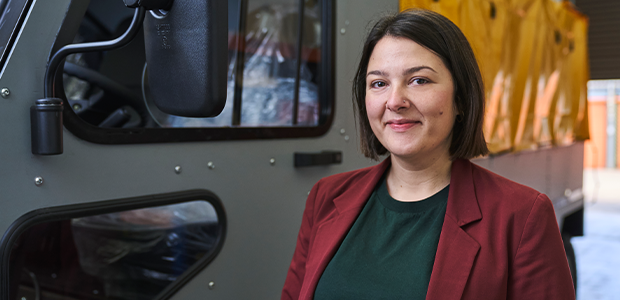
Determined problem solver Natalie Dowsett is about to supply thousands of off-road vehicles to Africa, to support a new transport service arrangement she has helped to introduce for farmers and traders.
Rwandan banana seller Marie-Louise no longer sleeps on the roadside with tonnes of fresh fruit, in between hitching rides on the long journey between wholesaler and her market stall, thanks to the efforts of a UK-based entrepreneur and accelerator led by Connected Places Catapult.
Natalie Dowsett from Leamington Spa met Marie-Louise as a customer of a ‘transport as a service’ model introduced by her company OX Delivers, which allows banana sellers and others to rent space on a large vehicle used by multiple people and their goods. “Her story really moved me,” says Natalie, who received funding and support from the Clean Futures accelerator led by Connected Places Catapult and Coventry University.
“She used to catch a bus to the wholesalers to buy bananas, but couldn’t get back on the bus because it was too full for her and her purchase. So she hitched rides that could take three days, and in the meantime her market stall was empty and she wasn’t earning. But now she is able to buy more, diversify her stock, increase her income, and be at home with her children instead of sleeping by a road.”
The service offered by OX Delivers allows farmers and traders in remote areas to ring a free phone number and book a place on a vehicle dispatched by a central hub. A digital platform determines the best routes for a community of drivers to take to pick up cargo in several locations. It also helps the team to better understand when demand for the service is likely to peak.
Soon, the second-hand trucks in use for the scheme in Rwanda will be replaced by new 3.5t electric trucks designed and built by Natalie and her team in the UK. They recently secured an order for 2,500 vehicles over four years from a franchise partner. The company has raised nearly £10 million in investment from four equity rounds over the last four years, and the deal to expand into East Africa is worth £123 million.
The new trucks are more rugged – allowing them to serve people away from paved roads – and are designed to be easier to maintain and cheaper to run. The company also hopes to create several manufacturing bases for the vehicles in Africa, and establish further franchises in countries in the east and west of the continent – while continuing to oversee and further develop the vehicle design and digital platform that underpins the transport booking service.
“Across the global south, three billion people lack access to motorised transport, which stifles business prosperity,” she explains. “People don’t need a whole truck, but want to use part of one. Our business model means that if you want to move 200 kilos of potatoes two kilometres, that's what you pay for.”
Operations began in Rwanda before a new truck was ready, so that the company could start serving customers and understand the demand, the typical inclines the vehicles will face, and how fast they need to go; without over-engineering a truck that would be too expensive and not fit for purpose.
Motor racing memories
Natalie, who grew up in Stockport, Greater Manchester, would often ask seeking questions, and remembers yearly trips with her family to the Le Mans 24-hour race in France which “set my path for life”. Every year they stayed in the same hotel as former racing driver Derek Bell who, Natalie remembers, was “generous with his time and allowed me to sit in his racing car”.
One year Derek came third in a race, and as he entered the hotel reception in front of press photographers, placed his trophy down in front of Natalie and asked her to look after it while he went to his room. “I wouldn’t let anyone touch it,” she recalls.
She later told her father she wanted to be a racing driver, but he was not too keen. “So, I asked how I could get into the pits” and aged 11, she became “laser focused” on wanting to be an automotive engineer.
Natalie did well at GCSEs but struggled with A-Levels and was determined to get to university, so “talked my way” onto a course in Mechanical Engineering at the University of Salford which focused on aerospace applications, and was allowed to progress on the basis that she worked really hard. She did, achieved her degree and “landed my dream job” as an engineer at Jaguar Land Rover after completing a work placement there.
She remembers getting involved in a product re-design which, to her mind, was unnecessary. “I was frustrated and drove everyone in my team mad, because I kept asking why we are doing this. I was told: ‘Why don't you go to the team that makes these decisions, and learn from them?’ So I did.”
Natalie went into product strategy, looking at how vehicle design might need to adapt in seven to 10 years in response to market changes and regulation. She led several teams that brought together engineering, marketing and finance, before joining the international PR function. While at the company, she met software specialist and future business partner at OX Delivers, Simon Davis.
Making swift progress
In 2019, she decided to switch career and founded an e-commerce business “to understand what it takes to build a brand”. One day, Simon called her up and spoke about “this project called OX” where an entrepreneur needed a new business model to provide fit-for-purpose vehicles in Africa.
The pair teamed up and took on the business. Covid had just struck, but funding was available from several sources and the company grew. It developed several iterations of its truck, built the data platform, and today employs a team of 40 mostly based in the UK. It has also started equity fundraising to scale the business, so it can fulfil its order of 2,500 vehicles. The company has also featured in Time magazine as one of the best innovations of the year.
Two years ago, OX Delivers was welcomed onto the Clean Futures accelerator in the West Midlands to develop a digital management system for its truck manufacturing processes in order to reduce cost and save time. The funding went towards the cost of software engineers based in Birmingham who developed the technology. Alongside this, the team received support from manufacturing technology experts at Coventry University’s Institute for Advanced Manufacturing & Engineering, who are partners on the Clean Futures programme.
“We've really benefited not just financially, but from having a platform to talk about what we do,” she says. “Connected Places Catapult helped open us up to networks of people and partners to interact with. The support we got was really valuable.”
Natalie is reluctant about being described as an ‘innovator’ and prefers to see herself more as “a curious human”.
“It's a privilege to be considered an innovator, but I probably shy away from it a little bit. Innovation isn’t always about flashy tech. It can be about a simple, fit for purpose, utilitarian truck that has a face only a mother can love! It’s about recognising that innovation is about challenging what is considered the norm, challenging what is there, and asking ‘why?’.
For more startup news, check out the other articles on the website, and subscribe to the magazine for free. Listen to The Cereal Entrepreneur podcast for more interviews with entrepreneurs and big-hitters in the startup ecosystem.