

You can’t run and reinvent with the same people

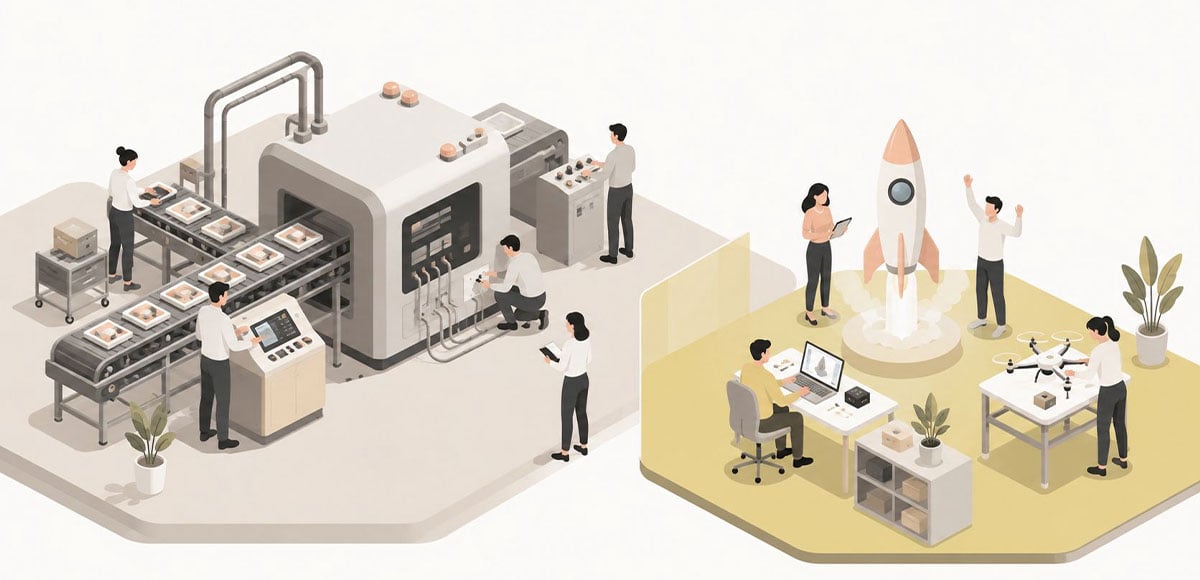
Almost every big company has tried some version of innovation: a lab, an incubator, a transformation office, a ‘digital team.’ A lot of them produce slide decks instead of products that anyone can use. It’s rarely about money or talent. The failure is usually structural, and it’s almost always the same one: the company asks the people running the business to invent its future in their spare time.
That doesn’t work, and it’s worth being precise about why – because the version that does work looks superficially similar, and companies keep confusing the two.
Running and building are different jobs
The common model is to ask people to spend a fifth of their time on new ideas and the rest keeping existing systems running. On paper, it sounds balanced. In practice, maintaining something that already exists and building something that doesn’t are different kinds of work, with different rhythms and different definitions of done. A large company is, for the most part, a set of processes that repeat without fail, and the people who run them have a full-time job keeping them that way. Add ‘go invent the future’ on top, and the new work gets whatever attention is left over, which is rarely much. You can’t switch from maintaining to inventing because a calendar says it’s now your 20% time.
McKinsey’s research found that 84% of executives considered innovation important to their growth, while only 6% were satisfied with how their innovation was performing. A gap that wide reflects how the work is structured rather than any shortage of talent, and the same structural problem shows up almost everywhere you look.
Why does a separate team work
Here’s the part most write-ups get wrong, including a lot of the criticism aimed at corporate labs. A real lab works well when the team has its own perimeter, its own budget, its own targets, and nothing to maintain. What fails is the fake version: innovation bolted onto the existing operation, run by the same people, measured on the same dashboards.
The clearest evidence I know is an old Harvard Business Review study by O’Reilly and Tushman. They looked at 35 attempts at breakthrough innovation. More than 90% of the teams set up as structurally separate units, with their own people and their own processes but a direct line to senior leadership, hit their goals. None of the cross-functional teams bolted onto the core did, and only a quarter of the conventional functional setups did. Separation accounts for most of the result on its own. That finding is not new, but it holds and ignoring it costs far more today than it did then.
The speed gap is now the whole game
I work in an AI-native company, and the thing that’s hard to convey to people who haven’t felt it is the speed. An idea in the morning is in front of real users by the afternoon. We build, ship straight to production, watch what happens, and change it the same day. Nobody waits on a release committee, a quarterly roadmap negotiation, or a shared team booked weeks in advance. The loop between ‘what if’ and ‘we know’ is hours.

Now hold that next to how the same work moves inside a large incumbent: an idea waits for a slot, then for sign-off, then for a slice of an engineer who already has a day job keeping the existing system alive, then for three other functions to agree it’s a priority. A change that takes us an afternoon takes them a quarter, and that has little to do with talent, since their engineers are often the stronger ones. The delay comes from how the work around them is organised.
This is where the part-time model stops being merely inefficient and becomes fatal. When companies competed mainly on strategy or capital, a slow innovation function was a weakness that a business could absorb. Now that the competition runs on speed, splitting people across run and change costs more than half their time, because a coordination tax sits atop the lost hours: partial allocation, cross-functional sign-offs, and goals that point in different directions. A dedicated team of five compounds what it learns every day. A part-time effort spends most of its energy re-aligning before it can move at all. The difference between the two grows faster the longer it runs.
You can see the result in almost every category with a large incumbent: a swarm of small, fast players has appeared, each iterating in hours while the incumbent iterates in quarters. Their time-to-market is often several times faster. That comparison is already generous, since it assumes the incumbent is even in the race, when plenty of part-time labs never ship anything.
The mistake companies make twice
When this fails, the company usually decides it needs to move faster, which skips past the cause: it took people who were good at running the business, handed them the future to build on the side, and expected both to come out well. Telling those same people to pick up the pace only repeats the mistake. The lesson here is not that labs fail. A half-built lab, one with no dedicated people, no budget, and no separate scoreboard, was never a lab to begin with. When a handful of focused people can ship in an afternoon, that half-version offers no route to the future at all. Either set the team up properly, with its own perimeter and resources, or leave it alone.
For more startup news, check out the other articles on the website, and subscribe to the magazine for free. Listen to The Cereal Entrepreneur podcast for more interviews with entrepreneurs and big-hitters in the startup ecosystem.
