

Is the UK a startup sweet spot?

It’s a story I’ve heard over and over again. A startup creates a company in the UK. Investors invest in that early stage. They cultivate a beautiful company. Then, once the company has got going, that support falls off a cliff-edge. The company uproots and takes its success to foreign shores.
And that’s the way it remains … right? Wrong!
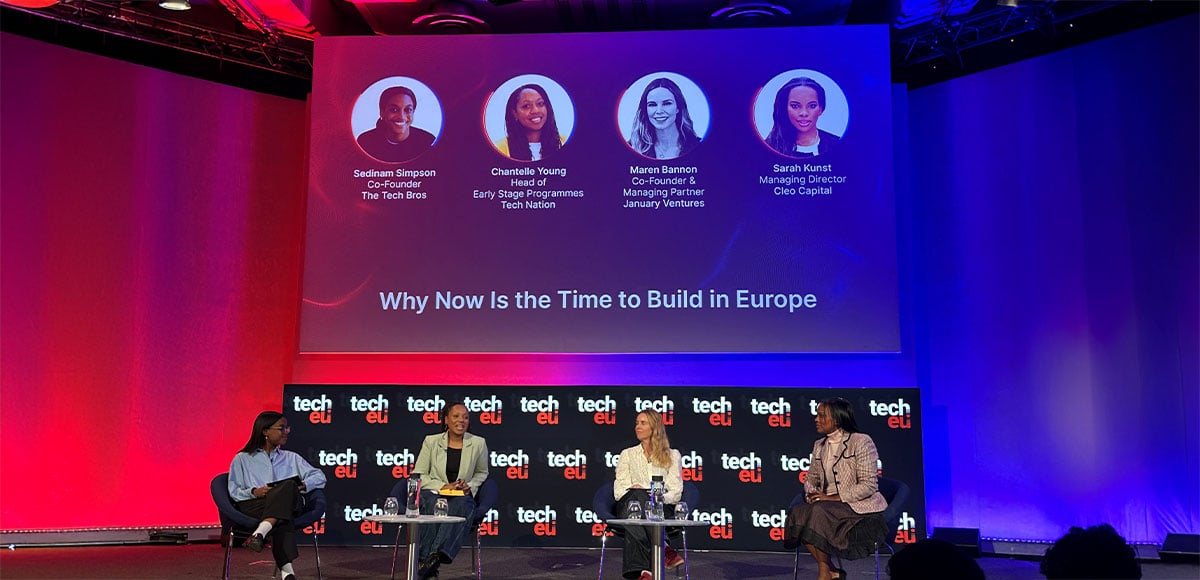
The UK and Europe are on the rise, with the UK being considered the number one spot for startups in Europe, according to Chantelle Young, Head of Early Stage Programmes at Tech Nation, speaking at the Tech.eu Summit London 2026.
Young was part of a panel discussion with fellow panellists Maren Bannon, Co-Founder & Managing Partner, January Ventures; Sarah Kunst, Managing Director, Cleo Capital; and moderator Sedinam Simpson, Co-Founder, The Tech Bros – and it seems that we aren’t as bad as we think.
The birth of globalised thinking
It started with COVID, a catastrophic event that knocked the world off its axis – metaphorically speaking. But from that came a realisation that companies and their teams are not beholden to a specific location. This gave rise to the oxymoron of a more separate, connected future.
Geopolitics is also responsible for reshaping the roadmap for ambitious founders. The US, once considered the ultimate destination for many scaling tech companies, is looking increasingly turbulent. Kunst said that visa crackdowns are hitting even senior tech workers, with companies like Microsoft openly advising employees not to leave the country for fear they won’t be let back in. Meanwhile, the political and social climate has made the American dream feel, for many, more like a nightmare.
The result? European founders are choosing to stay. And the data backs that up. Young cited 163 unicorns were created in the UK, with 90% of the still-active ones choosing to remain on home soil. Moreover, 42 of those unicorns have gone on to fuel 259 further startups across the UK, raising over $4.4 billion in the process – proof that success, when it does happen here, is increasingly feeding back into the ecosystem rather than vanishing abroad.
The champions of frontier
Not only is the UK retaining companies, but it’s also building the next generation of them. Young highlighted a decisive move away from iterative consumer startups toward “frontier tech”: deep tech, life sciences, space tech, and AI-adjacent science spinning out of world-class universities. The Golden Triangle of Oxford, Cambridge, and London remains a particular hotbed, but the Midlands, with its growing health tech cluster, is making its own case.
Bannon echoed this, saying that European founders are increasingly making a “contrarian choice,” one that, in her view, speaks to genuine conviction. “In the Bay Area, founding a company is almost the default,” she said. “Here, you’re going against the grain.” That, she says, tends to mean that founders have a sharper focus and stronger intent.
Defence, too, is having what Kunst described as “its moment. ” It’s a sector that would have seemed an unlikely startup play just a few years ago, but one that geopolitical realities have made urgent and well-funded.
The barriers that remain
However, if the UK and Europe are really going to thrive, some structural friction needs to go. Kunst noted that one big obstacle is the cost of starting a venture fund. In the US, registering with the Securities and Exchange Commission costs in the region of $5,000. In the UK, the regulatory framework means founders are looking at something closer to $500,000 over the life of a fund when working through an umbrella company. That’s roughly 100 times more expensive, and that cost has a cascading effect on the whole early-stage ecosystem.

However, by having more venture funds means that more investors can deploy capital at the pre-seed and seed stage, which means more founders get their first cheque, which means more companies get built. The US doesn’t have a sovereign wealth fund propping up its startup scene; it has a low barrier to entry for fund formation, which has created a self-sustaining flywheel of capital and ambition. The UK, Kunst points, is leaving that flywheel on the table.
Telling a better story
One big call to action that came from the panel is the way the UK presents itself to the world. Bannon notes the UK’s biggest problem might simply be the way it talks about itself. “Brits can be a bit self-deprecating,” she says, urging the ecosystem to stop framing London as a “New Palo Alto” and to instead start telling its own story on its own terms. The UK has deep academic talent, a large English-language market, relatively affordable hiring costs compared to Silicon Valley, and a social safety net that – as Kunst points out – actually makes the risk of founding a company far more manageable than it might feel.
The panel also says that broader, more collaborative thinking across European borders is needed. The EU needs to be treated not as a collection of separate markets, but as a single, powerful tech bloc that, when viewed as a whole, can rival the US in scale and ambition.
So there you have it, the opportunity is here, the infrastructure is growing, and the timing may never be better.
For more startup news, check out the other articles on the website, and subscribe to the magazine for free. Listen to The Cereal Entrepreneur podcast for more interviews with entrepreneurs and big-hitters in the startup ecosystem.
