

Why differentiation doesn’t work and how startups can win through de-positioning


I was in a boardroom with Fortune 500 leadership when it became clear how broken most brand strategy has become. For over an hour, the group debated what made their brand ‘different.’ The walls were covered with sticky notes, and on them, words like ‘innovation,’ ‘creativity,’ ‘customer obsession,’ and ‘culture’ were written. Still, something was missing.
No one had mentioned the customer’s problem.
That moment summed up the issue with how most brands are built. Companies spend a vast amount of time defining how they stand out and far too little time proving why they matter.
After decades of working with brands at every stage of growth, I came to realize that differentiation isn’t just outdated; it’s risky. Markets move too fast. Features are copied within months. Differentiation doesn’t last. Real advantage comes from solving customer problems so that competitors are rendered irrelevant.
That’s the foundation of De-Positioning, a strategic framework we developed at Fazer to help brands win by converting customer pain into competitive power.
The end of differentiation
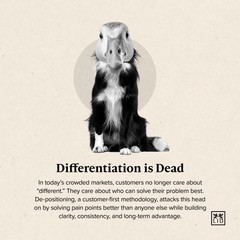
For more than fifty years, marketing has centred on differentiation. Find a white space and own it; however, white space doesn’t stay white for long. In today’s environment, innovation cycles are short and ideas spread instantly. What was once unique becomes expected almost overnight.
Differentiation is a brand-first strategy. It asks, ‘How can we stand out?’
De-Positioning reframes that question. “What’s the customer’s biggest pain, and how can we solve it better than anyone else?”
Customers aren’t looking for originality. They’re looking for relief.
What is de-positioning?
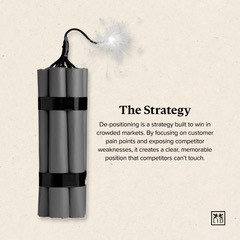
De-Positioning isn’t about being different. It’s about exposing competitors as incapable of solving what matters most to customers. Think of it as strategic judo: using competitors’ strengths, scale, and even their messaging against them.
It draws on the Engel-Blackwell-Miniard model of consumer behaviour. Customers don’t remember who was most distinctive; they remember who solved their problem best.
Instead of chasing white space, De-Positioning creates it by reframing the problem, so your solution feels inevitable, and competitors feel irrelevant.
The Six Principles of De-Positioning
Through the client work at Fazer, and the research into my book, De-Positioning: The Secret Brand Strategy for Creating Competitive Advantage, we identified six principles that help brands out solve and outperform their competition.
-
Champion the customer
Winning brands start outside their walls. They focus less on mission statements and more on the customer’s frustration.
Zoom didn’t reinvent video calls. It made them reliable. That focus on dependability turned it from a product into a habit.
Start with the customer’s frustration. That’s where loyalty begins.
-
Be a hero pain solver
Every category has one pain so large it defines the customer’s day. Find it, fix it, then make competitors look slow for missing it.
Netflix didn’t win by being cooler than Blockbuster. It eliminated late fees and inconvenience. Salesforce did the same by removing complexity from enterprise software.
Solve the pain your competitors ignore, and you win by default.

-
Know Competitors’ weaknesses
Strategy isn’t polite. Every competitor has a vulnerability, something they can’t or won’t fix. Expose it through contrast.
Apple’s ‘I’m a Mac / I’m a PC’ campaign didn’t insult Microsoft; it reframed it as corporate, outdated, and slow.
Strategy isn’t about saying you’re better. It’s about proving competitors no longer qualify.
-
Own one big idea
A brand can only stand for one thing.
Volvo owns safety. Tesla owns innovation. Apple owns privacy.
Leaders often overcomplicate their story in search of distinction. Discipline wins attention, simplicity drives memory.
Own one idea so completely that no one else can touch it.

-
Cohere or die
Every touchpoint, product, and service must reinforce the same promise. When stories splinter, trust erodes.
Companies can pivot as markets evolve, but coherence is non-negotiable. The tighter your story, the faster belief spreads.
Consistency, not volume, builds belief.
-
Integration wins. lack of it kills.
Integration is the new competitive advantage. Apple’s ecosystem makes switching feel like regression. Amazon’s integration makes every alternative feel inefficient.
In a modern marketplace, integration ensures that customer journeys reinforce your core promise, from start to finish.
Integration isn’t a feature. It’s how relevance becomes dependence.
The future: Competing in the AI decision moment
AI is rewriting how customers discover and choose brands. Soon, they won’t browse options. They’ll ask AI assistants for recommendations, and it will choose one.
Algorithms don’t reward creativity. They reward clarity, consistency, and trust. Brands that win in this new environment will be those the algorithm deems most relevant, not most different.
Every brand signal, review, and customer experience must reinforce your authority as the best problem solver in the category.
In this new world, differentiation fades. Ultra-relevance decides.
The new competitive weapon
Visibility without focus is noise. De-Positioning reframes brand strategy as a business weapon, not a communications exercise. It’s not about being different. It’s about being indispensable.
In a world of infinite choice, people don’t remember who was different; they remember who made their lives better.
The next generation of iconic brands won’t win by shouting louder. They’ll win by solving smarter.
The future won’t reward brands that look different, but the ones that make a difference by solving with precision, purpose, and relevance.
For more startup news, check out the other articles on the website, and subscribe to the magazine for free. Listen to The Cereal Entrepreneur podcast for more interviews with entrepreneurs and big-hitters in the startup ecosystem.
