

MatAlytics awarded £619k grant funding to bring structural physics AI to steel sector

MatAlytics, a provider of structural physics AI for critical industrial assets, has been awarded £619,000 in grant funding from Innovate UK. This builds on the previously awarded £100k funding received from Innovate UK. To succeed with this current funding round competition, MatAlytics had to nominate and demonstrate a highly scalable Proof of Concept (PoC) stage AI technology, that aligns with the UK’s strategic need for AI sovereignty.
Born out of a PhD research programme at the University of Nottingham in 2010, MatAlytics successfully proposed a frontier AI PoC within the steel manufacturing sector based on deploying its CITRUS software. The physics AI embedded in CITRUS will enable steel and metal manufacturers to predict the thermomechanical behaviour and microstructure of steel slabs and components faster and more accurately using physics-based AI; replacing costly, slower and less accurate simulation methods that are dated. This will enable the industry to reduce operating costs, carbon emissions and improve the production, quality and consistency of products – all of which supports the UK’s requirements set out in ‘The UK steel strategy’, announced in March.
Commenting on the grant funding achievement, Damien Jefferies, Innovation Lead – Frontier AI, Innovate UK says: “This grant funding is well-deserved. Innovate UK’s Frontier AI programme encourages UK AI talent to build and scale frontier AI companies in the UK, supporting globally competitive technologies that align with national priorities and which deliver real-world impact.”
Alongside this, research by Grand View Research suggests, “The global steel market size was valued at $1494.0 billion in 2025 and is projected to grow from $1525.8 billion in 2026 to $2283.0 billion by 2033, at a CAGR of 5.9% from 2026 to 2033. The market in Asia Pacific dominated with a revenue share of 64.6% in 2025. The global steel market is anticipated to be driven by rising investments in construction activities.” So, global applications are immense.
Dr Benedikt Engel, CEO and Co-Founder, MatAlytics says: “This Innovate UK funding is a significant milestone that validates our frontier AI capabilities here in the UK. It enables us to accelerate the development and industrial validation of our CITRUS platform, advancing our physics-based AI from a promising Proof of Concept to a deployable solution. This grant not only strengthens our technology roadmap. It enables us to gain early commercial traction with UK industry partners, reinforcing British leadership in sovereign, physics-informed AI for critical industrial applications. Additionally, at a very practical operational level, it means we can take on more technical and commercial staff to support our roadmap and future customers’ needs.
“Further, although this project centres on steel, physics AI can monitor industrial assets across the energy sector, including thermal power generation, nuclear/fusion, small modular reactors (SMRs), the hydrogen economy; offshore/oil & gas; aerospace & defence; and automotive.
How physics AI improves steel and metal production: cutting costs and emissions
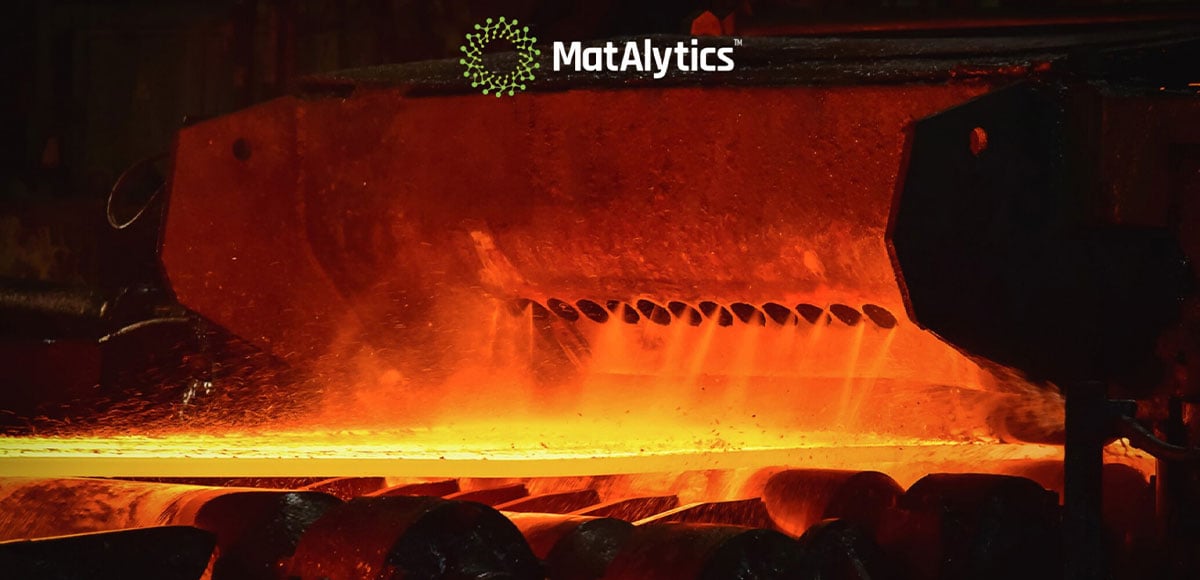
A current bottleneck experienced during industrial steel and metal manufacturing/production occurs during the reheating process of steel and metal slabs, prior to rolling or heat treatment. During production, these slabs must pass through gas-fired furnaces that are expensive to operate and manage. Every minute these slabs spend in these necessary gas-fired furnaces is extremely costly for steel and metal producers. Therefore, optimising the reheating time, temperature profiles, and energy use of furnaces is vital for cost reduction and decarbonisation.
To solve this problem, MatAlytics can provide a foundational physics-based AI model that accurately understands how steel behaves under extreme reheating conditions. The model rapidly predicts thermomechanical behaviour, microstructure evolution, and final mechanical properties with high precision. Prior to MatAlytics’ physics AI, running these simulations demanded complex, resource-heavy simulations on high-performance computing systems, often taking hours or even days. In comparison, MatAlytics’ CITRUS platform delivers results in seconds.
This breakthrough gives steel manufacturers real-time, actionable insights that delivers a range of benefits. Substantial reductions in natural gas consumption and energy costs can be achieved by optimising reheating cycles. Product quality and consistency can be improved by managing precise microstructure control. Mill productivity and throughput can be increased and CO₂ emissions can be reduced, supporting the UK’s net-zero ambitions. Finally, this allows for faster innovation and reduced dependency on costly external simulation services.

CITRUS software and physics-based AI
For this steel PoC, MatAlytics’ CITRUS software and technology provides the foundational model that understands how various thermomechanical stresses are taking place within steel manufacturing plants and facilities. At the heart of CITRUS lies an innovative system of neural networks, trained extensively on the outcomes of finite element (FE) simulations.
These simulations, known for their precision, predict a wide range of parameters such as internal stresses, damages, temperatures, and more, based on component-specific material properties and load cases. However, while FE simulations are highly regarded for their accuracy, carrying them out has previously been considered impractical for real-time decision-making due to their long computational times. Physics-based AI from CITRUS is changing this.
The neural networks upon which CITRUS is built are pre-trained on FE simulations that can rapidly interpret incoming sensor data from components, transforming this data into actionable insights about damage, stress levels and estimated component times.
For more startup news, check out the other articles on the website, and subscribe to the magazine for free. Listen to The Cereal Entrepreneur podcast for more interviews with entrepreneurs and big-hitters in the startup ecosystem.
