

Inside Carbon13’s mission to back the world’s boldest climate founders

When it comes to climate tech, the stakes are brutally simple: if a traditional B2B SaaS startup fails after four years, its founders can pivot and try again. If a climate tech startup fails after four years, they’ve lost four critical years of emissions reduction.
That hard truth sits at the heart of Carbon13, a venture builder and accelerator designed specifically to help founders create high-impact climate startups from the ground up. Founded in 2020 and based in Cambridge, London, and Berlin, Carbon13 exists to dramatically increase the number and quality of climate ventures emerging from the UK and Europe.
“The company’s overall objective, especially in 2020, was to fight the climate emergency,” explains Sara Jones, Head of Marketing, Carbon13. “And one way to do that is to massively increase the amount of climate tech startups that the UK and Europe produce.”
WHY CLIMATE STARTUPS NEED A DIFFERENT KIND OF SUPPORT
Climate tech is different from other verticals. The timelines are longer, the technologies deeper, and the consequences of failure far more serious.
Carbon13 focuses on two of the biggest barriers founders face:
1. Finding the right co-founder(s)
“One of the hardest things is to find a co-founding team who has complementary skill sets, is investable, is committed to the mission and the problem, and is ready to start now,” says Jones. “Co-founder breakup is one of the biggest reasons why startups break up.”
2. Embedding climate impact into the DNA of the business
Carbon13 trains founders to strategise from a carbon impact point of view rather than treating climate as an add-on.
“We need these startups to understand how to evaluate the impact at a significant global level and have that in lockstep with the commercial strategy.”
Climate for Carbon13 isn’t just “CO₂ reduction” in the narrow sense. The organisation works with ventures across nature, biodiversity, water use, microplastics, electrification, and broader planetary boundaries. Startups can be working on everything from direct carbon removal to enabling platforms that unlock impact elsewhere – as long as they can plausibly scale to reduce 10 million tonnes of emissions per year.
“You don’t need to know how to get to 10 million. We help you figure that out,” Jones notes. “But there has to be the potential … and the litmus test is: do you, as a founder, care?”
TWO PROGRAMMES, ONE MISSION
Carbon13 runs two flagship programmes tailored to different stages: Venture Builder
The Venture Builder is the best-known programme and is explicitly built for founders at day zero – even if they don’t yet have an idea.
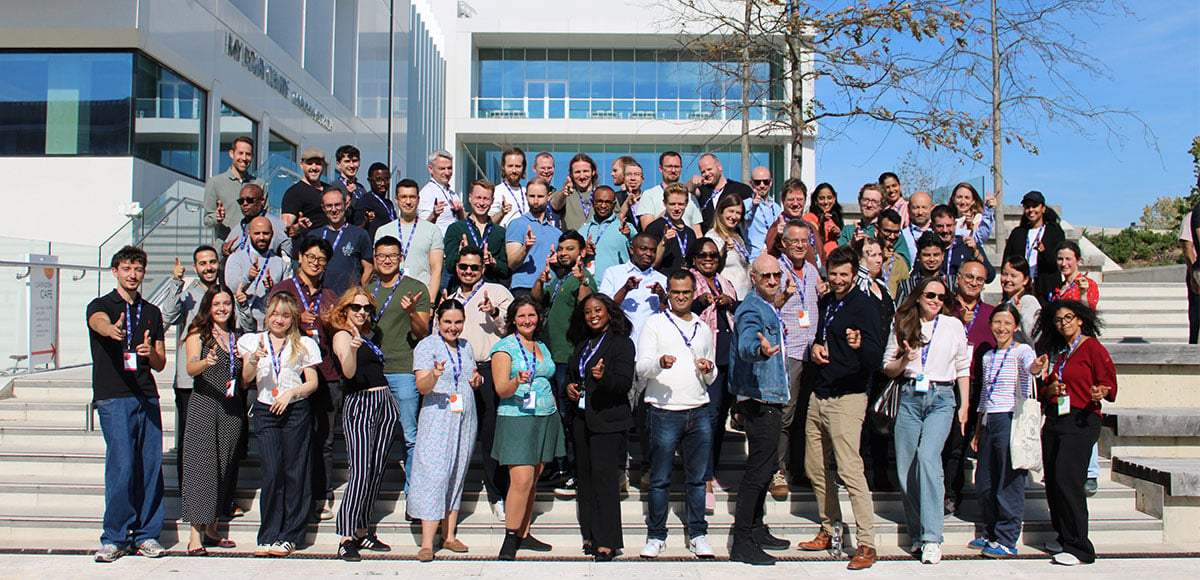
“It’s a cohort of 80 people who are coming together because they want to find co-founders,” notes Jones.
Some arrive with fully-formed concepts or research they want to commercialise, others with only industry insight or a problem they care deeply about. What Carbon13 looks for is not the perfect pitch deck, but deep commitment to building a climate tech startup, readiness to form a high-performing co-founding team, and ambition for global emissions impact.
The programme runs across roughly 8-10 months in three phases:
1. Teaming phase
Founders meet, test working relationships, begin ideation, and are introduced to impact thinking. This is the only fully in-person phase.
2. Investment case sprint
Teams that form progress to building their case for investment: clarifying technology, problem, market, and impact, and preparing for Investment Committee. Around 20 teams may pitch; 5-10 typically receive investment.
3. Post-investment support
Tailored support to refine milestones, fundraising strategy, technical roadmap, and investor introductions.
Venture Accelerator
The Venture Accelerator targets startups that are earlier than a traditional accelerator, but further along than day zero:
- Typically, co-founding teams of at least two
- A clear idea, often with prototype or research at TRL 4–7
- Usually pre-equity funding, or with only a small amount raised
The programme is 10 weeks, fully virtual, and highly bespoke. Teams spend the 10 weeks building a compelling investment case and then, like the Venture Builder, pitch for Carbon13’s investment. Around three to five of roughly 15 will typically secure funding, followed by an additional 10-12 weeks of support.
SUCCESS STORIES: FROM STEEL AND CEMENT TO AUTONOMOUS SHIPS
With its 100th startup investment recently completed, Carbon13 now has a growing portfolio of climate ventures.

One of Jones’ favourite examples is Cocoon Carbon, a deeptech startup born from the Venture Builder: “It’s a really good example of a founding team that would never have met but for this programme.”
Two technical founders working on decarbonising steel were matched with a seasoned commercial founder who had already built and exited a medtech startup. Together they built a business that uses steel by-products to create low-carbon cement materials. They’ve raised about $5 million in just 18 months from first meeting to follow-on funding which is unusually fast for deeptech hardware.
Another recent investment focuses on AI simulation for testing autonomous vehicles, initially in the marine environment: “At the moment, Waymo will be testing physical cars on physical roads, doing millions of miles of testing, costing billions of dollars … and a lot of emissions,” Jones notes.
By shifting much of that testing into simulation – especially for complex marine contexts – the startup aims to radically cut both costs and emissions.
These stories, Jones emphasises, illustrate Carbon13’s real superpower: “The single biggest thing that Carbon13 does is help people find their co-founders. That is the single biggest impact that we have.”
A TOUGH FUNDING CLIMATE – AND A BIG OPPORTUNITY
Like the wider VC market, climate tech is currently in an investment trough. But Jones is adamant this is precisely why now is the right time to start: “Many valuable companies are created in a trough. The thing about climate is the problem is not going to go away. In fact, it’s going to get worse.”
Perhaps most importantly, starting now positions climate ventures perfectly for the 2030 horizon, as science-based targets bite and the world demands scalable solutions.
“2026 is a brilliant time to raise,” Jones argues. “Because by 2030 the world is going to be screaming for the solutions that people start building now.”
Carbon13 is now accepting applicants from around the world for the Venture Builder (as long as they can attend in-person days), and its Accelerator is opening up to non-UK startups registered in certain European countries, including the UK and Germany.
The message to potential applicants is clear: “No one should select themselves out of an application … based on age or experience or skill set. We’re looking for commitment to the mission, commitment to building a startup, and a mix of intelligence, drive, and resilience.”
For ambitious founders willing to tackle real-world problems, Carbon13 is betting that the next generation of climate unicorns is already out there. It’s just a matter of getting them in a room, helping them find each other, and building from day zero.
This article originally appeared in the January/February 2026 issue of Startups Magazine. Click here to subscribe
