

Venus Safety: protection disguised as style

To live as a woman means being hyper-vigilant to your surroundings. Travelling alone, taking public transport, or something as mundane as going for a walk can invite unwanted attention. This feeling of unsafety as a woman alone was Nahla O’Rourke’s inspiration behind founding and developing Venus Safety. The initial idea came as part of O’Rourke’s final year university project, after being tasked with creating something that “wouldn’t bore us after six months of research and design.”
Considering her love of solo travel, from moving to Denmark for a furniture design job, to travelling around Thailand, staying in budget-friendly hostels, and making new friends along the way, O’Rourke reflected on what could be improved.
“As a product designer, you try and find ‘pain points’ – these are opportunities for your design to improve an experience,” O’Rourke explains. “Even in my happy moments travelling abroad and going out with friends, there was always a common thread of fear. Who is staying in my hostel room tonight? Is this a safe bar to drink at?”
There’s one particular moment in Thailand that she recalls drove a lot of the design choices. “I had gone out with a friend for a drink, ended up separated from her, and stuck talking to an older man whose tone kept shifting and becoming more suggestive. It was a situation that’s hard to explain, but every woman knows the feeling. He hadn’t said anything outright aggressive yet, but I needed to get out. Thankfully, I was able to subtly message a friend back in the UK to call me with an ’emergency’ and get back to my hotel. But the experience stuck with me. Speaking to friends back home, I realised this is actually all too common. Everyone had a story, some weren’t as lucky as I was to be able to escape.”
The inspiration and drive behind the Venus bracelet was always O’Rourke’s personal experiences, and those of the women around her. She commented: “Violence against women and girls is an epidemic, even being declared a national emergency in 2024.” Safety devices are a growing market, and a wearable like Venus is here to make safety a priority.
Venus
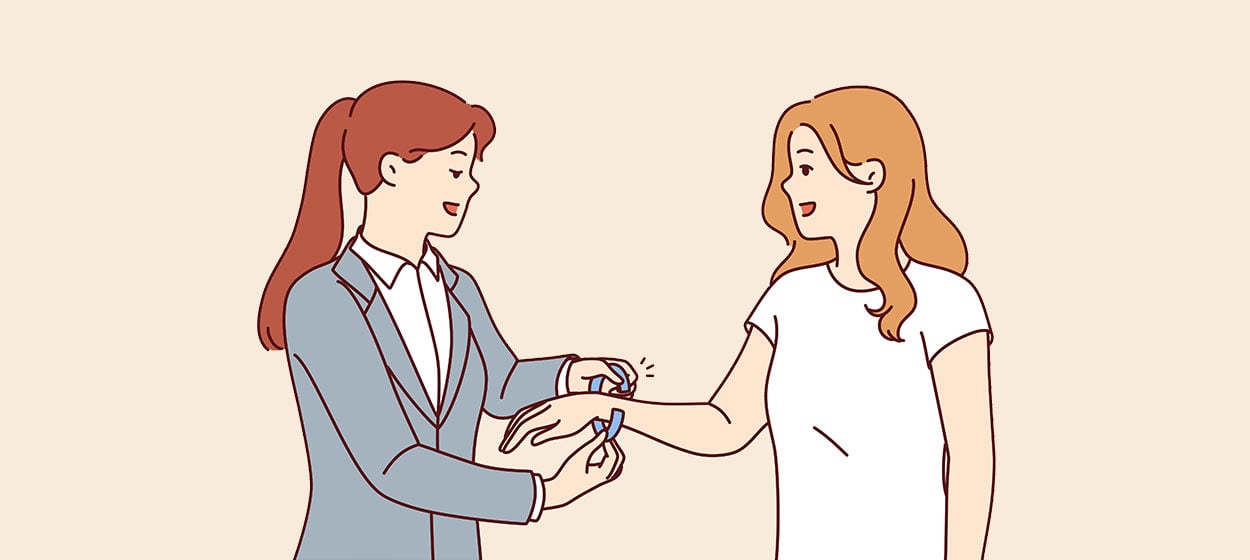
Venus is a wearable safety device designed to look like jewellery. “It doesn’t mark you as a victim, or over-cautious.”
The wearable is paired with a companion app, and uses BLE (Bluetooth Low Energy) to send press-pattern signals to the paired phone. One press triggers a fake incoming phone call, two presses send a GPS alert to trusted contacts, and three presses starts covert audio recording. The thought behind this is simple: “All of these features are driven by insights from real women, about real situations. It’s not always the big, blaring ‘worst-case’ scenario, often women have a premonition, and just need the infrastructure to be able to remove themselves from these uncomfortable situations, without escalating them.”
Venus Safety also has a companion app, where a community layer comes in. “Women can check in with friends, share real-time information about routes and locations on a safety map, and build safety habits together over time. Beyond launch, the plan is to bring AI into the product to detect changes in environments and trigger the right response automatically, so that the bracelet is working even when the wearer cannot act herself,” O’Rourke said.
O’Rourke detailed that what sets Venus apart from other solutions on the market is its discreet activation, which requires no screens. None of the features require the phone to be unlocked or the app to be open, as oftentimes, the moments when solutions such as Venus are needed most, are the moments where reaching for your phone would make things worse.
The device takes the form of jewellery on purpose, as O’Rourke realised what was wrong with the current safety device market: “So much of what is marketed to us looks exactly like a safety device. Products like clip-on panic buttons, keychain alarms, pendants that look exactly like a button. These products announce their purpose immediately, making the user visibly vulnerable. If a safety tool only works when you’re wearing it, then it needs to be something that women genuinely want to put on every day.”
Challenges and highlights
When asked about the challenges so far, O’Rourke admitted: “The honest answer is that almost everything has been a challenge, because I started with a product design degree and no background in hardware engineering, software, law, or fundraising. I have had to learn all of it from scratch, mostly by doing it wrong first.”
The first hurdle was hardware. She knew what she wanted the bracelet to be, but turning it into a product that worked was a challenge in its own right. “I built my advisor network specifically to fill the gaps I couldn’t fill myself, and that took time to get right. Not everyone I brought in early was the right fit, and learning to make changes when something isn’t working is its own skill,” O’Rourke explained. Being a solo founder can be difficult, and this advisor network she has built has helped, but challenges persist. “There is no one to split the load with on a bad week. What I’ve found is that the advisor network I’ve built serves some of that function, and the community at Sparkhouse [a business incubation centre on the University of Lincoln’s Brayford Campus] has meant I’m not doing this entirely alone. But I won’t pretend it isn’t hard sometimes.”
Every founder cites funding as a challenge, and O’Rourke agrees. “I came into this knowing nothing about SAFEs, SEIS, valuations, or cap tables. I still remember the first time someone asked me what my pre-money valuation was and I had no idea what they meant. I have spent a lot of hours since then getting to a point where I can hold that conversation confidently, and I think being a solo founder has actually forced me to understand things more deeply than I might have if I’d had someone else to hand it off to.”
No matter the challenges that have presented themselves, the people and support keep her going. “The thing that has kept me going through all of it is the waitlist. Over 550 people gave me their contact details without being asked twice. That number was built with no marketing spend, no product in their hands, just a BBC article and a degree show. On the days where everything feels difficult, that is what I come back to.”
Looking to the future
Looking ahead to the next year, O’Rourke’s goal is to get Venus Safety into people’s hands for the first time. The startup is currently completing a bridge round, which should take the business to the end of 2026, and will fuel the groundwork, including the design-for-manufacture study, legal infrastructure, and the early preparation work that needs to happen before it raises a full pre-seed round at the end of 2026.
By the end of 2027, O’Rourke hopes to have the physical product in the hands of early access customers. “The milestone I care most about is not a number. It is the first time a woman uses Venus Safety in a moment where she actually needs it, and it works.”
In the long-term, O’Rourke sees Venus becoming “a hardware company, a platform, and a movement.”
The mission is to become a brand that women trust. The foundation will be the hardware, but the companion app, the community safety map, and the trusted contact network will evolve Venus into more than a product. “Over five years, with enough users feeding real-time information about routes and locations and experiences, Venus Safety starts to look like infrastructure. The kind of thing that changes how women move through the world, not just how they respond when something goes wrong,” O’Rourke explained.
Behind Venus is also a movement, which is harder to plan for. O’Rourke described the vision: “The people on the waitlist did not sign up because they wanted a gadget. They signed up because something resonated. Every woman who finds out about Venus Safety already understands the problem it is solving, because she has lived it. That shared experience is the foundation of something bigger than a product company, and I want to build towards it purposefully.
“In five years I want Venus Safety to be the answer to a question that does not currently have a good one. Not ‘what app should I download?’, not ‘what alarm should I carry?’, but what would actually make me feel safer. I want the answer to be Venus, and for it to be obvious.”
This article originally appeared in the September/October ’26 magazine issue of Startups Magazine – see SM’s Magazine Archives for more featured publications.
For more startup news, check out the other articles on the website, and subscribe to the magazine for free. Listen to The Cereal Entrepreneur podcast for more interviews with entrepreneurs and big-hitters in the startup ecosystem.
