

How Planet Smart is rethinking disposable hygiene

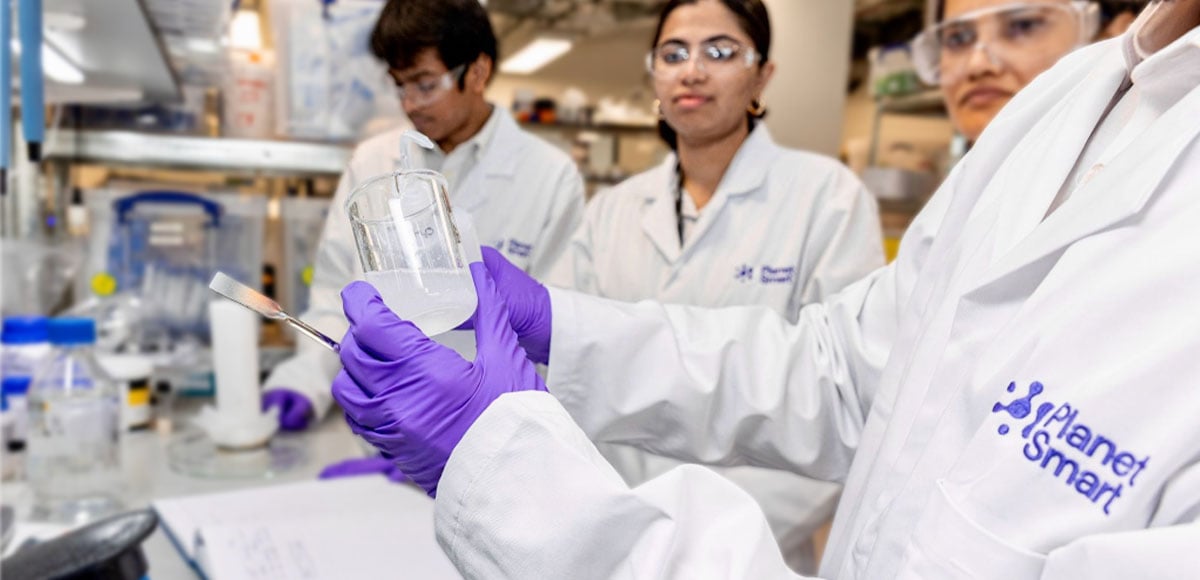
When Planet Smart founders Dr. Gerald Marin and Maurice Ruttimann first met, it was not in a laboratory or a boardroom, but as housemates in a London flat.
At the time, the two were working in very different worlds. Marin was a chemist by training, with a PhD in sustainable materials. Ruttimann had been working on sustainability issues in the public sector, with experience working for the United States House of Representatives and the European Parliament on sustainability policy.
Then the COVID lockdown happened and the pair got chatting about their respective work and their shared frustration with cutting global carbon emissions.“I come from the chemistry side, very focused on materials,” says Marin. “Maurice came from policy and government. We initially tried to tackle sustainability from the NGO angle, but we kept coming back to the same question: how do you actually move the needle at scale?”
The answer, they concluded, lay not in awareness campaigns or recycling schemes, but in creating a new biodegradable material which could be used in place of plastics – especially in the sorts of applications where it is hard to find an alternative.
So, they set up Planet Smart, a company which develops biodegradable super absorbent polymers, the hidden but essential component inside disposable nappies, menstrual pads, and adult incontinence products.
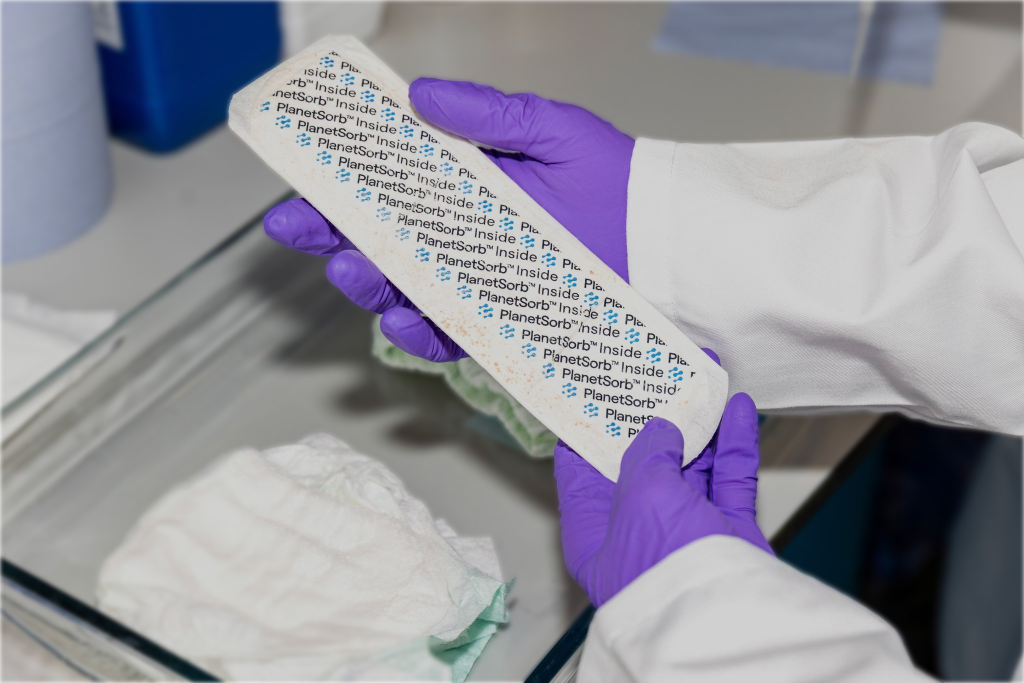
These polymers, which can make up as much as 30–40% of a nappy’s weight, are traditionally fossil-based plastics. They are highly effective at absorbing liquid, but they have almost no value once used, are difficult to recycle, and contribute to microplastic pollution.
Marin first encountered the scale of the problem while conducting river clean-ups in the Philippines. Hygiene products, he found, were among the most commonly collected items.“They’re bulky, unsanitary, and unlike bottles or packaging, they don’t get recycled,” he says. “They just keep resurfacing, literally.”
The industry’s reliance on plastic-based super absorbents has remained largely unchanged for decades. While there have been incremental improvements, Marin argues that none amount to a fundamental shift. “What we wanted to challenge,” he says, “was the assumption that super absorbents have to be plastic.”
Planet Smart’s core innovation, known as PlanetSorb, replaces fossil-based polymers with an amino-acid-based material. Amino acids are the building blocks of proteins and are naturally occurring, widely available, and far more compatible with biological degradation.
Although he is reluctant to disclose any proprietary details, Marin says that Planet Smart synthesises and polymerises a specific non-essential amino acid into a super absorbent material that matches, and in some cases exceeds, the performance of conventional products. “In lab-scale testing, we’re seeing faster absorption, and up to two times better performance on certain parameters,” he says. “Crucially, when this material breaks down, it does not fragment into microplastics.”
The idea did not emerge overnight. While still working full time, Marin spent evenings and weekends poring over scientific literature at the British Library, mapping the gaps in existing research. He consulted academic collaborators around the world, testing whether the concept was theoretically viable before attempting to build it.
Support from Innovate UK and Undaunted Accelerator allowed the company to move from theory to practice. Planet Smart now operates its own laboratory, has produced working material samples, and has completed third-party dermatological and eco-toxicity testing.
What it has not yet done is put a Planet Smart nappy on a baby. “That stage comes later,” Marin says carefully. “First, you prove the material. We test absorption under load, for example, to replicate what happens when a baby sits or moves. We also test skin safety independently. But full-scale product trials require industrial machinery, and that’s where scale becomes the challenge.”
The hygiene industry operates at enormous volumes. A single nappy machine can produce more than 1,000 units per minute. To integrate into that system, Planet Smart must manufacture super absorbent polymers at industrial scale.
Rather than building its own plants, the company plans to partner with existing contract manufacturers, leveraging established polymer chemistry infrastructure. This strategy, Marin believes, is what will allow Planet Smart to scale quickly enough to matter.
The company has already secured letters of intent and purchase orders from major hygiene manufacturers, including what it describes as “one of the largest players globally.” Its recent funding round is being used to finalise product specifications at lab scale, ahead of a larger raise focused on commercial production.
The obvious question is why large incumbents have not already done this themselves. “They’ve tried,” Ruttimann says. “But for 30 years, bio-based super absorbents have either been too expensive or not scalable. Sustainability projects inside big companies tend to remain side projects unless there’s real financial pressure.”

There are also structural barriers. Existing manufacturers have invested heavily in machinery optimised for plastic-based polymers. Switching materials would require not just innovation, but a rethinking of capital investments.
Some companies are exploring recycling-based solutions, attempting to recover absorbent materials from used nappies. Planet Smart takes a different view. “We haven’t solved recycling for everyday plastics,” Ruttimann says. “Why would we create entirely new infrastructure for hygiene waste, when we could just change the material itself?”
Cost remains the critical constraint. Planet Smart’s stated goal is to be cost-comparable with conventional super absorbents, once economies of scale are reached. Until then, further R&D and funding will be required.
The founders are realistic about the role of regulation and how government measures such as the plastic bag tax can make a radical change.
They say that although a ban on hygiene plastics could accelerate change and push more people to using reusable cloth nappies, governments must also recognise the limits of consumer behaviour. “Reusable nappies are more sustainable today,” Ruttimann acknowledges. “But they don’t work for everyone. People need convenience, especially working parents. Our aim is not to eliminate disposables, but to remove their environmental harm.”
Looking ahead, Planet Smart expects to enter pilot-scale production later this year, with commercial availability of products such as menstrual pads and nappies between late 2026 and 2027, assuming successful scale-up.
As for the plastic waste clogging rivers in Southeast Asia, Marin is clear-eyed. “This won’t solve everything,” he says. “But if a nappy ends up in a river, at least it won’t shed microplastics for decades. That’s a real step forward.”
Ultimately, Planet Smart’s ambition is to be absorbed into the very system it seeks to change. “Our end goal,” Ruttimann says, “is acquisition by a major brand, so this technology becomes part of the global supply chain. That’s how you create real impact.”
This article originally appeared in the January/February 2026 issue of Startups Magazine. Click here to subscribe
