

Picture perfect: how Camera Intelligence is rethinking creative workflow

Sheryl has trained in proofreading and copyediting with the College…
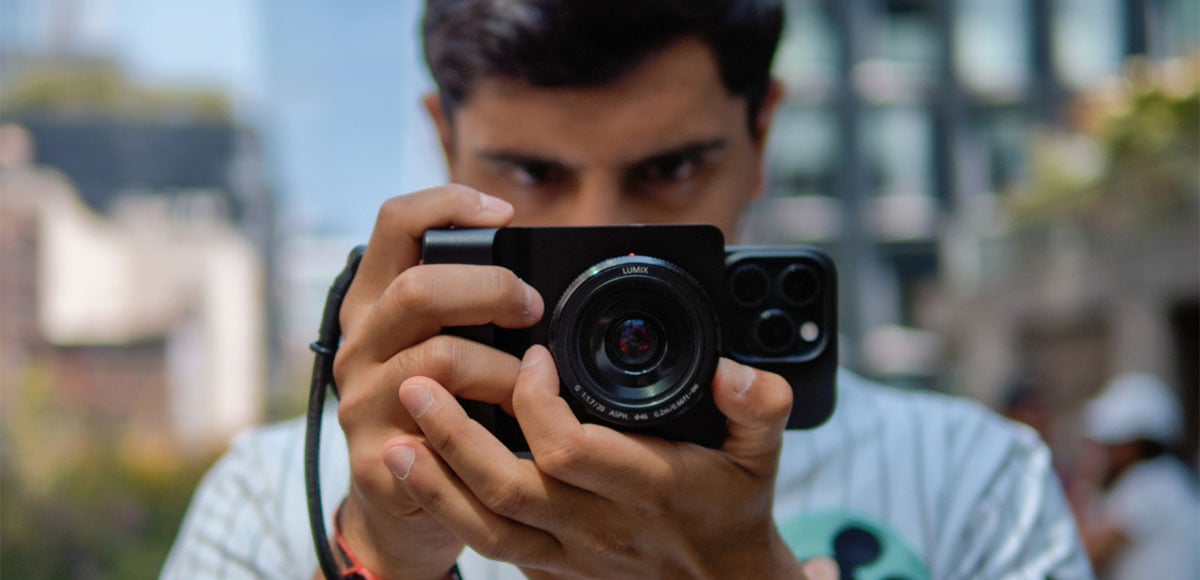
Camera Intelligence is bringing a new focus to the creator economy with its latest product, Caira. Caira is a camera that blends the optical quality of a professional camera with the AI-powered intelligence, connectivity, and intuitive user experience of a smartphone. The result is a tool that is designed for the fast-paced demands of content creators – a tool that promises to make capturing, editing, and sharing professional-quality images as simple as using a phone.
Camera Intelligence’s CEO and Co-Founder, Vishal Kumar, founded the company after noticing a widening gap between the quality of a traditional camera and the AI power of a smartphone. Kumar, a cultural data scientist, built an online following by uncovering insights about “the art market, creative industries, and cultural phenomena,” giving him what he calls “a unique perspective on the creator economy.”
He explains how the idea formed: “Traditional cameras offer superb quality, but lack the computational power and connectivity of smartphones. Conversely, smartphones, while incredibly smart, are limited by their small sensors and optics.”
That imbalance got him thinking about merging the best of both worlds – pairing professional optics with real-time AI processing and connectivity. The goal was to create a camera that gives content creators professional-grade tools that are “as intuitive and connected as their phones.”
FOCUSED ON INTELLIGENCE
“At our core, we are a computational photography company,” Kumar said. “Our proprietary deep learning models run on dedicated processors inside the camera to automate complex technical tasks, from advanced colour grading to noise reduction, in real-time.”
The company also integrates Google’s Gemini model via a Cloud API to edit photos post-capture, allowing creators to concentrate on storytelling instead of technicalities. “We’re giving storytellers a more intelligent creative partner.”
This combination of hardware, AI, and connectivity is designed to remove long-standing bottlenecks in content creation – where, as Kumar puts it, “creators are constantly forced into a frustrating trade-off: the superior optical quality of a traditional camera, versus the speed and intuitive software of a smartphone.”
The traditional camera workflow – involving SD cards, file transfers, and desktop editing suites – slows down creators who need to publish instantly. The Caira collapses that entire process into one connected device.
“By integrating a large sensor and interchangeable lenses with powerful onboard AI processors and 5G connectivity, we eliminate the trade-off,” said Kumar. “Creators get professional-grade quality with the shoot-edit-share immediacy of a smartphone – allowing them to stay in the creative driving seat, while saving time on laborious processes.”
SNAP DECISION
Caira’s setup is intentionally simple: “You attach your phone to the camera via MagSafe – Apple’s magnetic technology – and the camera is ready,” Kumar explained.
Instead of complex dials or layered menus, creators control the camera through their iPhone’s familiar touchscreen interface. “Our AI assists with settings in real-time, and editing is done directly on the device – allowing creators to publish content instantly via 5G or Wi-Fi.”
At the heart of the system is a Micro Four Thirds sensor, chosen because it offers “the perfect balance between professional image quality, compact size, and access to a vast ecosystem of high-quality lenses.”
Inside, a mobile chipset with a dedicated AI processor powers real-time computational photography models. The result is “a seamless, powerful, and connected creative experience.”
A DIFFERENT FRAME OF MIND
Camera Intelligence’s approach sets it apart from both legacy camera manufacturers and smartphone makers.
“We are a software and AI company that builds cameras, not a legacy hardware company trying to bolt on software as an afterthought,” said Kumar.
He sees two main groups of competitors: “Traditional camera giants produce incredible optics and sensors, but their software, user experience, and connectivity are notoriously clunky and disconnected. On the other hand, you have the smartphone market, who excel at computational photography and user experience, but are fundamentally constrained by the physics of small sensors and lenses.
“Camera Intelligence is unique because we fuse the best of both. We are the only player integrating a large sensor and interchangeable lenses with a powerful, AI-native architecture from the ground up. This allows us to offer uncompromised image quality with a seamless, intelligent workflow – something no one else is really doing.”
DEVELOPING THE BIGGER PICTURE
As an AI camera company that controls its hardware, firmware, and AI models, Camera Intelligence can continually refine its technology. “We aren’t just shipping a static product; we’re delivering a platform that evolves.”
Sharing an example of an over-the-air update that introduced a new AI model, Kumar said: “It allows a creator to upload their past work to the camera, which then learns that user’s unique colour grading style. They can then apply their signature ‘look’ in-camera, in real-time, as they shoot. This fundamentally changes the creative workflow. The fact that the Caira you buy on day one will only get better and smarter over time is a total game-changer.”
CLICKS AND BALANCE
The company’s growth has been steady and deliberate. A recent $2 million funding round enabled it to expand its core team to 10.
“First, we deepened our technical bench with specialists in computational photography, embedded engineering, and mobile development to accelerate. Second, we began building our go-to-market engine by hiring experienced leads in marketing, creator relations, and product design,” said Kumar.
“It’s a lean but incredibly talented team, and every person is passionate about redefining the future of content creation.”

The journey, however, has not been without obstacles. Despite the funding, Kumar describes the process as “a marathon, not a sprint.” Investor hesitation towards hardware products was one hurdle. Overcoming the negative responses from investors who prefer software took a lot of resilience and focus on the vision.
“It’s a real test of conviction,” said Kumar.
Global disruptions from COVID-19 also created setbacks, from manufacturing delays to software development challenges.
Yet, “through it all, we’ve shipped our first product to several hundred users, and have been really excited to receive great reviews.”
A further success was finding aligned investors.
“Without a doubt, [a high] was finding the right partners who see the world as we do. Those include Betaworks and Digital Catapult. The true victory wasn’t just securing the capital, but building a syndicate of investors with deep expertise in both hardware and the creator economy. That validation, and the ability to now scale our team and accelerate production, made all the challenges worthwhile.”
A GROWING ALBUM
With growing demand, Camera Intelligence is now expanding into the US market, where it has recently opened an office in New York.
“The US is our biggest sales market. We want to have more of a physical presence there with customers and creators,” said Kumar. The company is also scaling up its manufacturing capacity to meet customer demand.
“The future looks bright – but as ever, the hard work to continuously improve Caira’s capabilities, logistics, and provide the quality product our customers expect continues.”
This article originally appeared in the November/December 2025 issue of Startups Magazine. Click here to subscribe
