

Europe’s startup investors are chasing unicorns. Are women paying the price?


Speaking at SIM Conference in Porto recently, Miguel Aguiar, executive director of organiser Startup Portugal described the startup and investor matching process as “serendipity.” He said deals happen not on stage but on the banks of the river and in the corridors of the Alfândega do Porto, a customs house dating back to the 12th century. The Douro River, the beating heart of the city’s renowned port wine industry, was showing off that day. And Aguiar may have been right.
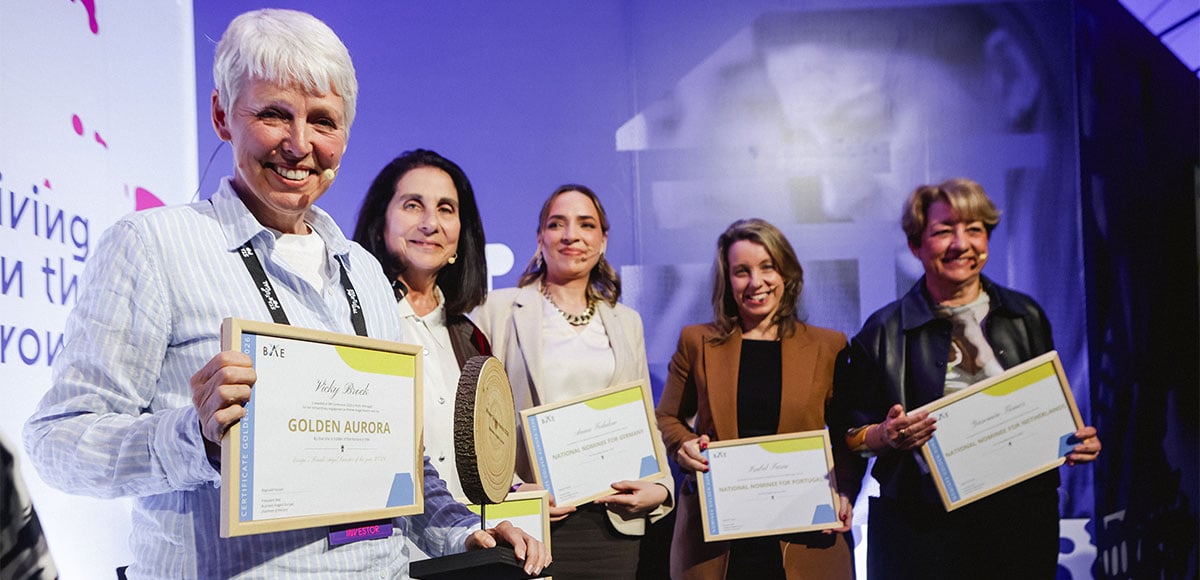
Within an hour of collecting the Golden Aurora award, Europe’s top prize for female angel investors, Vicky Brock was standing by the Douro, talking about what is wrong with the way Europe backs its startups but also what is right. She wasn’t alone. There were people everywhere, shaking hands and doing deals in the afternoon sun.
For Brock though, this was a culmination of events. A founder of five tech companies and two decades of experience, she now invests as an angel, putting the smallest amount a founder will accept into businesses as early as possible, and then, by her own admission, bugging the hell out of them.
But back inside the Alfândega, on a panel of six female angel investors, Brock had spent the afternoon making a case that went beyond her own story. Europe’s startup investment model, she and her fellow angels argued, is built around finding the next billion-dollar company. And in doing so, it is leaving the majority of founders, women disproportionately, without backing.
Unicorn myopia
The numbers bear this out. Female-founded companies raised €7.5 billion across Europe in 2025, the highest in three years and a 19% year-on-year increase, according to Female Foundry’s Female Innovation Index 2026, Europe’s largest annual analysis of funding driven by female entrepreneurs. Progress, undeniably. But that €7.5 billion represents just 13% of total European venture capital, a figure that has barely moved, up just one percentage point from the previous year.
And it is heavily concentrated too. The UK, Finland, France, and Germany alone account for 67% of all venture capital raised by female-founded companies across the continent. For founders outside those markets, or outside the sectors attracting the most attention (AI and deep tech between them took the lion’s share) the picture is considerably less encouraging.
Angel investor Yasemin Tumer, another Golden Aurora finalist on the Porto panel, spent three years tracking investment decisions within her own angel network. The findings are stark. Of 200 pitches from female-led companies reviewed over that period, 195 were declined, not because the businesses weren’t viable, but because the angels didn’t believe they would scale big enough.
“What happens to the 195 female-led companies?” she asked the room. “We cannot go on like this, looking only for the unicorn.”
Tumer was not alone. For Diana Vaturi, an angel investor who left a well-paid corporate career at McKinsey & Company to back early-stage founders, the problem runs deeper than money. Europe, she argues, has a cultural aversion to risk that stifles the very founders it needs most.
“We don’t have to cut their wings,” she said. “We have to encourage them to have vision. I want my founder to try, to fail, to risk, to enjoy.”
Isabel Faria, a Portuguese angel with 25 years’ experience in corporates said that in Europe “we still have this culture of the fear to fail.” She added that in the US, “they need to fail a lot before succeeding.”
It is a point that resonates across the panel. The obsession with finding the next billion-dollar company is not just leaving founders without backing. It is actively discouraging the kind of risk-taking that produces good businesses in the first place.
Anna Fedulow, Founder of Croton Capital, an international angel group that deliberately backs underrepresented founders across Europe, suggests that a way forward is syndication. Her syndicate model, with diverse angels pooling smaller cheques behind founders who would otherwise fall through the cracks, is precisely the alternative Tumer was calling for.
“Do not start alone,” she said speaking to any potential female angels in the audience. “You are stronger together.”
“I like pain”
Brock’s answer to the unicorn problem is deceptively simple. “I like pain,” she told BI Foresight recently. “I much prefer pain-led businesses.”
By that she means businesses that solve real problems rather than ones built around a technology looking for a market. The question she applies to every pitch is the same – what pain does it ease, and will people pay for a solution that is just a little bit less problematic than what exists today?
It sounds obvious. But as Brock points out, it is precisely the question that the unicorn-hunting model fails to ask.
“They just don’t give me a real-world story or a real-world problem,” she says of many founders she encounters. “It’s almost like if they do enough R&D and come up with a good enough solution, they can retrofit it to a problem.”
What she brings to the founders she backs is not primarily capital either.
“The least important thing I bring is my money,” she says. “Other people can bring more. I can bring a complete career of experience and contacts.”
What distinguishes Brock’s approach is not judgment, as VCs have plenty of that, but the kind of knowledge that only comes from the ups and downs of having lived the startup experience.
Sara Vitorino, a fractional COO who works with startups on scaling, sees the consequences of this daily.
“Women-led businesses often face a double standard operationally,” she says. “They’re expected to prove sustainability and structure before investors take them seriously, while male-led companies get funded on vision alone.”

The irony, she argues, is that this pressure to prove more actually produces better-built businesses.
“Women founders often build more carefully, which is actually an operational advantage if they get the support to scale it properly.”
But that support, she says, consistently arrives too late.
“The blockers I see most consistently aren’t about capability. They’re structural. By the time a woman founder reaches me, she’s often already done the hard work of building carefully but without the capital or backing to scale what she’s built.”
It is a gap that the angels in Porto are determined to close. The numbers from Female Foundry Index suggest momentum is building. Five new female-founded unicorns reached billion-dollar valuations in 2025, bringing the total in Europe to 29, the highest ever recorded. A further 21 are nearing that threshold, up 50% on the previous year. More female-founded companies are making it from Seed to Series A than the broader market average. The pipeline, slowly, is filling.
For the angels gathered in Porto, this is welcome reading but does not detract from the fact that early-stage female founders are still struggling to find backing. It is, if anything, a competitive space in Europe now, which says a lot about how startup culture is changing.
For the angels on the banks of the Douro, it’s not about waiting for the existing model to fix itself but in building something alongside it. Syndicates, smaller cheques, angels working together rather than alone.
“The female way of angel investing has come to life,” says Tumer. “And we’re designing it as we go along.”
She is clear about what that means in practice – female founders should not wait for the traditional investment model to come to them. The communities, the syndicates and the angels willing to back businesses that will never be unicorns but will be valuable, sustainable and world-class, are out there. And they are growing.
And for any prospective European female founder, that can only be a good thing.
For more startup news, check out the other articles on the website, and subscribe to the magazine for free. Listen to The Cereal Entrepreneur podcast for more interviews with entrepreneurs and big-hitters in the startup ecosystem.
