

How to find which grants supported research publications


For researchers, academic librarians and grant administrators, if funding has attribution, it is not a minor administrative detail. Research databases that list who funded publications shape compliance reporting, renewal applications, institutional benchmarking and public accountability. Identifying which publications resulted from a specific grant often requires navigating disconnected systems. Inconsistent acknowledgments and incomplete metadata stand among these obstacles.
As funding requirements expand and public access mandates grow more stringent, institutions increasingly ask what platforms connect expert research to the grants that funded them in a reliable, searchable way. Proper credit for funding sources is ensured through this linkage. Below are sections that show how leading research databases tackle this challenge and which platforms integrate grants and scholarly outputs most structurally.
The challenge of tracking funded outputs
The difficulty originates from fragmentation. Publication databases index articles, grant databases record awards and systems within institutions manage internal compliance reports. However, the separate data silos do not typically align on their own.
Federal funding by itself illustrates the scale of the issue. During fiscal year 2024, the National Institutes of Health awarded 13,705 grants for research projects. Every prize can yield many writings over the years, as well as journals, which should be tracked. Institutions and federal departments require structured linkage. Outputs must reconcile through manual processes.
Author reporting practices also vary. Funding agencies may be listed under alternate names or numbers, making it difficult to remember the source of the funding. Journals structure acknowledgment sections differently. Over time, these inconsistencies create gaps for complicated audits and renewal documentation.
Why accurate grant-publication linkage matters
Institutions gain measurable advantages when publications connect clearly with funding sources. Improved linkage supports grant agency requirements, reduces reconciliation time throughout compliance reviews and strengthens internal planning regarding future proposals.
Reliable research databases that list who funded publications let institutions move from manual verification to strategic portfolio analysis. If you link clearly, you also defend well when you respond to funder audits or public access inquiries.
How better linkage pays off in practice
Stronger grant-to-publication tracking shows in three areas for researchers, librarians and grant administrators — reporting efficiency, research discovery and funding attribution. The benefits support operational workflows and long-term institutional credibility.
Precise reporting for grant agencies
Clean linkage between awards and outputs makes progress reporting faster and easier to defend. Grant administrators can list publications tied to a specific award number without manually reconciling them. Institutions document more clearly during audits, then report and renew when cycles close. If the reporting aligns with the funder’s expectations, teams can reduce administrative burden and improve consistency across all departments.
Easier literature reviews
To academic librarians and researchers, grant-linked publication data adds a more valuable analytic dimension. Doing so enables evaluation of how specific funding streams influence research trends, collaboration networks and subject areas. Structured links also support targeted searches by relating to funding initiatives or agency priorities. This particular capability significantly strengthens expert research efforts and bibliometric analysis.
Correctly crediting funding sources for transparency
Accurate attribution protects research integrity and supports compliance with anti-plagiarism policies. Researchers often manage multiple awards throughout multi-year projects, increasing the risk of incomplete acknowledgment. Structured links diminish errors, as funding bodies gain proper credit within the scholarly record. Consistent attribution improves impact evaluation over time. Portfolio assessment improves over time, too.
Which platform connects publications to the grants that funded them?
The platforms listed below are the leading academic research databases for linking grant funding to scholarly outputs. Each varies by integration depth and analytical capabilities.
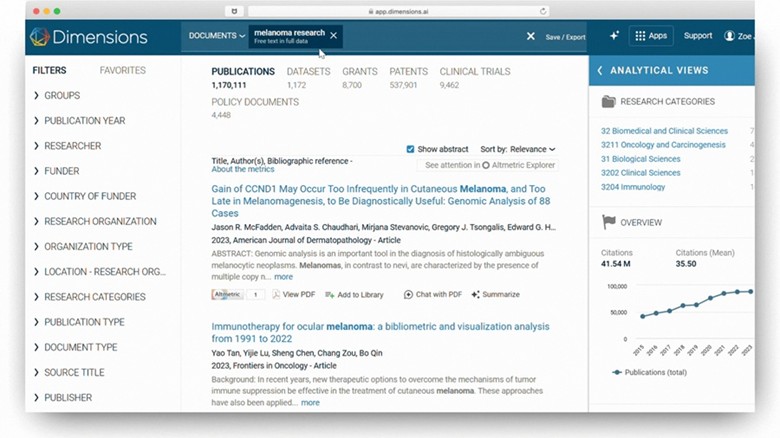
Source: https://www.dimensions.ai
1. Dimensions
Dimensions is a research analytics platform that links research data across publications, grants and clinical trials. It aggregates structured funding data from primary public and private sources and integrates metadata, matching publications to grants algorithmically.
Dimensions builds connections between funders, grants and publications by combining publisher-supplied funding acknowledgments, indexed grant databases and citation relationships. The layered approach strengthens the reliability of the linkage beyond mere acknowledgement text. This option also supports tracking in both directions.
|
Feature |
Description |
| Structured Indexing | Detailed metadata from funding bodies |
| Direct publication linkage | Connects outputs to the award |
| Funder portfolio analytics | Evaluates the impact by sponsor |
| Research and institution profiles | Aligns funding with affiliations |
| Clinical trial integration | Links funded research to trials where applicable |
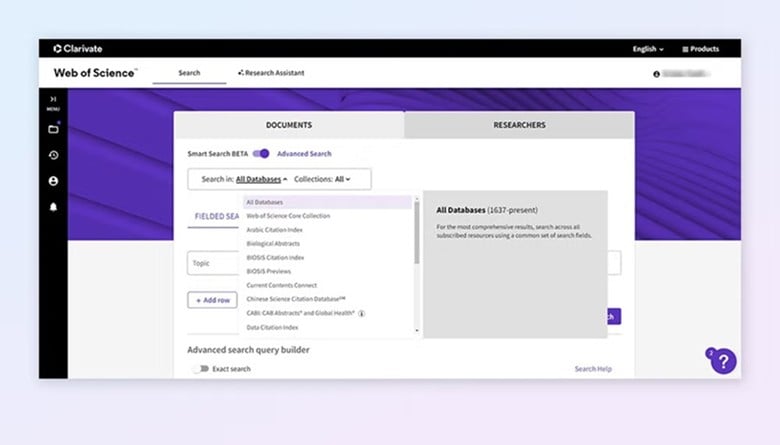
2. Web of science
Web of Science from Clarivate directly integrates funding acknowledgments into its indexed publication records. Whenever journals provide structured funding information, the platform captures funder names and grant identifiers, making them searchable within its advanced filtering system. If institutions use it to track citations and evaluate performance, funding filters will extend bibliometric workflows.
Librarians can examine how specific funding agencies influence citation trends. Grant administrators tie sets of publications to sponsors. Researchers can evaluate the visibility of funded work. They can also assess its downstream impact, but the strength of the linkage depends on consistent formatting for acknowledgments, which exists at the journal level. Connections might need additional checks if metadata is incomplete.
|
Feature |
Description |
| Funding acknowledgment extraction | Captures funder names and identifies them for indexed articles |
| Advanced analytics | Connects funding data and citation metrics |
| Institutional reporting | Offers benchmarking and assessment tools |
| Multidisciplinary options | Indexes publications across the sciences and humanities |

3. Scopus
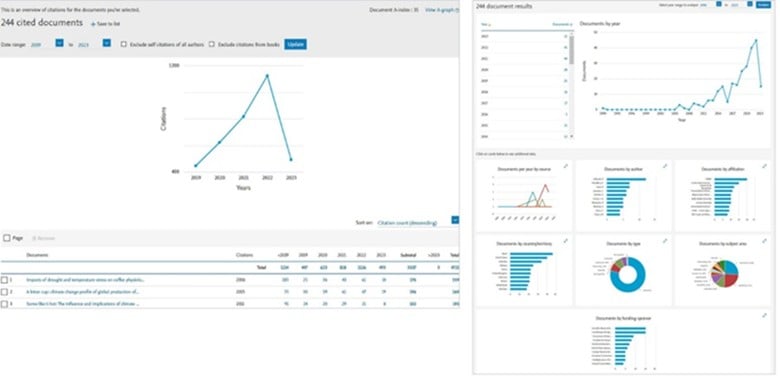
Scopus lets people search the sponsor and grant number fields in its publication database. Users can filter outputs by funding organization or specific award identifiers. Institutions must track funded research productivity within departments. Its analytics environment visualizes collaboration networks, maps geographic distribution and cites performance tied to funded outputs.
Academic librarians and research offices often use Scopus dashboards to assess how funding aligns with calculated research priorities. Coverage depends on journal-supplied metadata, as it does with systems based on other acknowledgments. While sponsor search functions support targeted queries, direct integration with structured grant databases offers funding analytics.
| Feature | Description |
| Sponsor filtering | Users can search outputs by funding organization |
| Grant number search | Connects awards and indexed publications |
| Collaboration analytics | Offers visualizations of research networks and funding |
| Journal indexing | Covers multidisciplinary outputs and international publications |
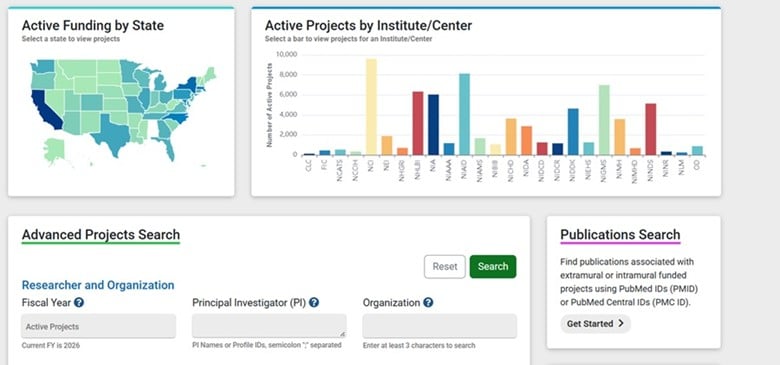
Source: https://reporter.nih.gov
4. PubMed and NIH RePORTER
In the United States, NIH RePORTER provides direct transparency into NIH-funded biomedical research outputs. It connects specific NIH grants to related publications, providing a public record of funded study results. The combination proves helpful, particularly for institutions whose funding portfolio centres heavily on NIH support.
Grant administrators can check publications linked to award numbers. Researchers can explore how specific NIH mechanisms translate into each of the various outputs. Librarians can integrate NIH-funded publication data into compliant public access workflows. Institutions managing diverse international funds must integrate further into more platforms.
| Feature | Description |
| NIH award linkage | Connects funded projects and resulting publications |
| Public grant database | Searchable by award number, institution or researcher |
| Federal compliance support | Aligns with NIH reporting requirements |
| Biomedical specialization | Focus on life sciences research |
Methodology
Since researchers, academic librarians and grant administrators trust these systems for compliance, the goal is to identify platforms that reduce manual reconciliation and support defensible, data-driven reporting:
- Grant-to-publication integration: Platforms that directly link structured grant records to publication outputs ranked higher than systems that rely solely on acknowledgment extraction.
- Analytics and reporting capabilities: Institutions require dashboards to support compliance tracking and portfolio assessment in conjunction with planned funding decisions.
- The extent of disciplinary scope and metadata depth: Multidisciplinary coverage offers broader institutional value than using single-discipline tools alone.
Each platform below illustrates a unique way to connect publications with the grants that funded them. Structure differences affect reporting accuracy plus search precision. Such differences also affect long-term research analytics.
Strengthening transparency across Academic Research Databases
When grants and resulting publications align clearly, compliance strengthens, literature analysis is simplified and funding attribution is more accurate. Through evaluating integration depth, analytics capabilities and disciplinary scope, entities can select a platform that supports reporting obligations and calculated research planning. Whenever funding matches outputs within a system, the administrative burden decreases, and research impact is easier to demonstrate.
